

 中文简体
 English
 русский
 Inquiry
Don't hesitate to send a message
I. Introduction: Solving the "Impossible" Task The phrase "fitting a square peg into a round hole" is a universal symbol...
READ MOREThe answer to what does a wood drill bit look like is usually settled in five seconds under a workshop lamp. A sharp centring point sitting below two raised spurs means brad point. A tapered screw thread at the tip means auger. A flat steel ring with a fine knife edge and a shallow body means Forstner. A hollow square tube with a small auger turning inside it means mortise chisel. The handle, the paint and the packaging change none of that.
That quick check earns its keep. Wood bits share drawers with twist bits for metal, carbide-tipped masonry bits and budget spade bits, and picking the wrong one costs more than a slow cut. A metal bit pushed into oak at high speed burnishes the hole wall and loses its edge within minutes. A masonry bit crushes timber fibres instead of slicing them and leaves a ragged, oversized hole that no dowel will hold. Reading the geometry is the cheapest way to avoid both mistakes.
Anyone asking what does a wood drill bit look like is really asking a practical question: which bit is in my hand, and what was it built to do? Our wood drill bit guide sorts this family by material. This article sorts it by sight, feature by feature.
Content
A wood drill bit is identified by four visible features: the tip geometry, the spurs or rim, the flute pattern and the shank. Read them in that order and a brad point will never be mistaken for a twist bit again.
Work down from the point. The tip shape names the family before any other feature does.
Timber produces long stringy chips, and flute count is how a maker buys clearance for them.
Round shanks fit a three-jaw chuck, hex shanks fit quick-change holders and impact drivers, and a fat welded carbide insert means the bit is for masonry rather than timber. A bright polished body with a black oxide or lacquered finish is normal for wood bits. A plain twist body with a point angle between 118 and 135 degrees is a metal bit, and no amount of sharpening will make it cut clean timber.
Definition: a wood drill bit is a rotary cutting tool tuned for timber, with a sharp, low-angle cutting edge and a wide open flute that clears long stringy chips rather than the short brittle swarf a metal bit produces.
| Family | Tip | Flute | Typical diameter | Typical job |
| Brad point | Centre point plus two spurs | Single or double | 3 to 12 mm | Cabinet work, dowels, clean entry holes |
| Auger | Tapered lead screw | Single, double or triple | 6 to 38 mm | Deep boring, framing, cable runs |
| Forstner | Centring point or screw behind a rim | Rim cutter, no chip flute | 10 to 50 mm | Flat-bottom recesses, hinges, plugs |
| Spade or flat | Small pyramid point | Two wide wings | 6 to 38 mm | Rough holes in softwood |
| Square hole | Hollow chisel with inner auger | Inner auger only | 6 to 16 mm | Mortises for joinery |
A brad point looks like a twist bit that grew teeth. Two raised spurs sit on the shoulders either side of a sharp centring point, and those spurs do the real work: they score the fibres in a clean circle before the cutting edge lifts the waste out, which is why the entry hole in veneered ply or oak shows almost no tear-out.
Spur condition is the first thing to inspect on a used bit. A chipped or rounded spur still drills, but the surface fibres tear and the hole edge turns fuzzy. Extension versions carry the same geometry on a longer shaft, so a 250 to 400 mm extended brad point reaches through thick stock from one side instead of forcing you to flip the workpiece and risk a misaligned exit hole.
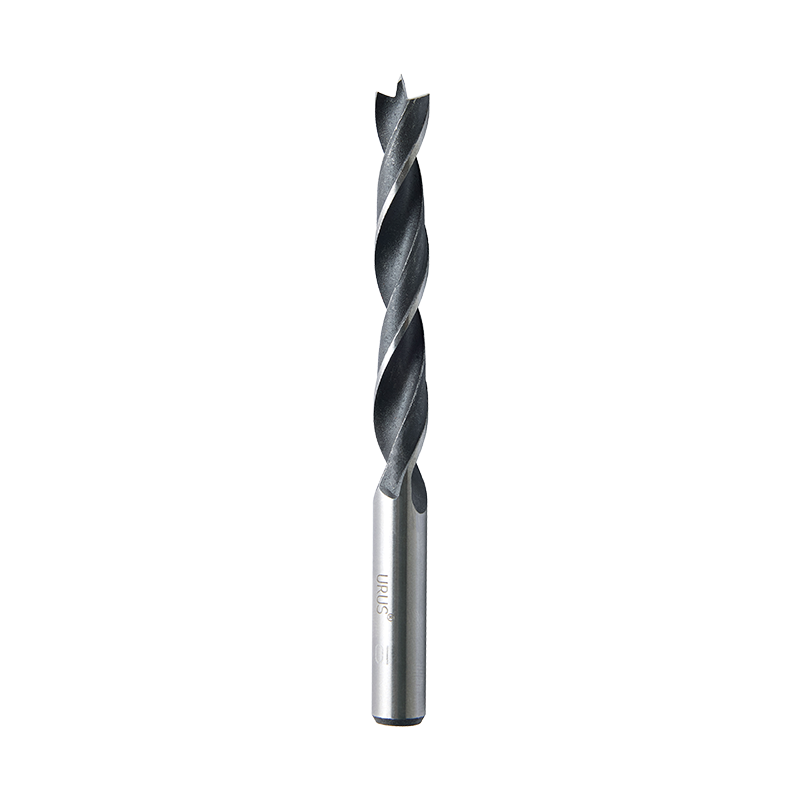 Standard Brad Point Wood Bit with Precision Center PointStandard brad point wood bit with a precision center point, single land and round shank, available in a range of marked dimensions for wood drilling.View Product →
An auger is the only common wood bit with a screw at the tip, and that screw makes it recognisable at arm's length. The lead screw threads into the timber and drags the cutting head forward, so the operator supplies rotation rather than feed pressure. The result is a fast, self-feeding cut that clears long chips from a hole many times deeper than the bit's own diameter.
Flute count separates the sub-types. A single-flute auger has one wide polished channel and leaves the cleanest wall. Double-flute and tri-flute versions evacuate chips faster and suit production boring. A bellhanger bit adds a cross hole through the tip so cable can be threaded straight into a wall cavity, while ship and boarding augers use a coarser screw and a heavier body for wet timber and framing work.
Shop floor rule of thumb: a single-flute auger leaves the cleanest wall but feeds at roughly half the pace of a double-flute bit. Finish and speed are a trade, not a free upgrade.
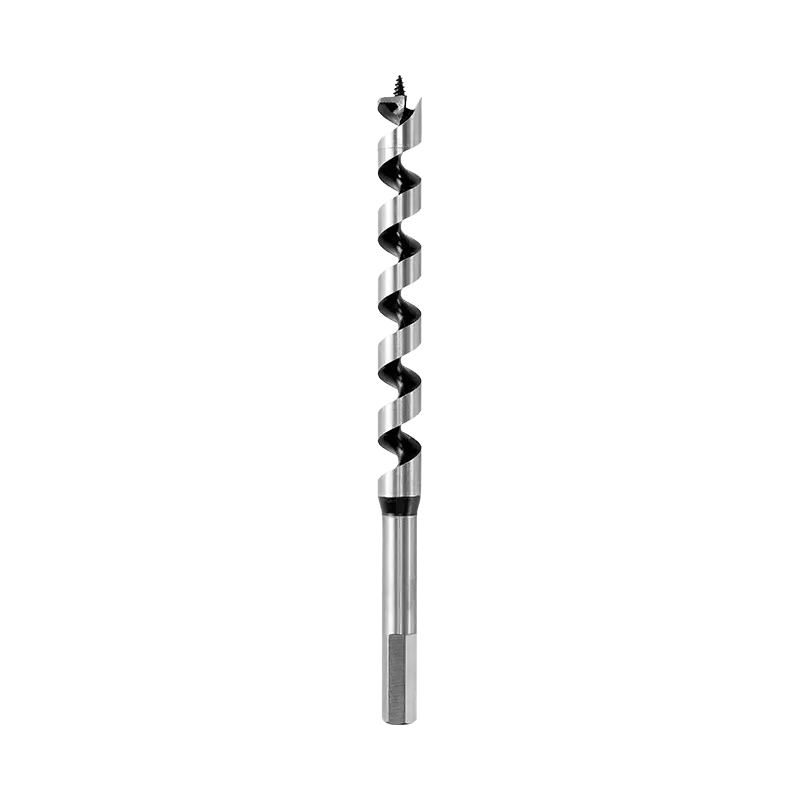 Custom Single Flute Auger Bit with Self-Feeding Screw PointSingle-flute wood auger bit with a self-feeding screw point, wide lands and hex shank, offered in multiple lengths, diameters and shank finishes.View Product →
A Forstner bit looks like a short steel cup with a knife edge around its mouth. The rim shears the fibres around the perimeter, the flat body scrapes the waste towards the centre, and the result is a flat-bottomed hole whose wall sits square to the surface. That geometry is why cabinetmakers reach for one when fitting hinges, sinking a recess or cutting plugs.
Square-hole bits are a two-part tool. A hollow, four-sided chisel cuts the outer walls while a small auger inside removes the core, which turns a round drilling motion into a square mortise. They belong on a mortiser or a drill press with a chisel holder, not in a hand drill, because the chisel must enter and leave perfectly vertical.
A small fixed point centres the bit on a marked line and holds it steady in plywood, veneer and end grain. Best when the surface must stay clean and the workpiece can be clamped.
A fine threaded point pulls the bit into the wood with less downward pressure, which speeds up deep recesses in softwood but needs a firm grip because it can snatch on breakthrough.
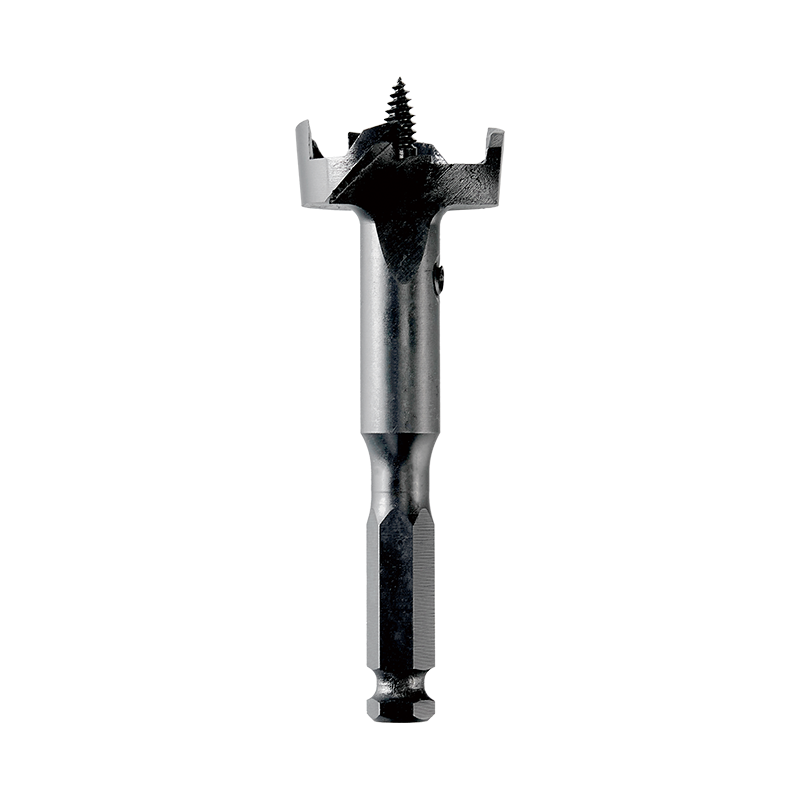 Custom Screw Point Forstner Bit for WoodworkingScrew-point Forstner bit with a replaceable tooth tip for fast boring in wood, cork, cardboard and MDF, listed in diameters up to 117 mm.View Product →
Wood bits are the only family with a low point angle, a wide open flute and a tip made entirely of hardened steel with no insert. Metal bits keep the twist body but narrow the flute and open the point to 118 or 135 degrees, while masonry bits end in a welded carbide tip that is wider than the body itself.
| Feature | Wood bit | Metal bit | Masonry bit |
| Tip | Point, spurs, lead screw or rim | Plain conical point | Welded carbide insert |
| Point angle | Low, roughly 60 to 90 degrees | 118 to 135 degrees | Blunt and wide |
| Flute | Wide, open, polished | Narrow, tight spiral | Shallow, deep channel |
| Cutting action | Slices fibres | Shears metal | Crushes and hammers stone |
| Machine | Drill, drill press, mortiser | Drill, bench drill | Hammer drill, SDS rotary hammer |
Importers judge a wood drill bit programme on repeatability rather than on a drawing. Four checks decide most orders.
Zhejiang URUS Tools Co., Ltd. manufactures wood, metal and masonry drill bits alongside pliers and cased tool sets from its plant in Jiashan, Zhejiang. The company holds ISO 9001:2015 certification, operates a TUV Rheinland cooperative testing laboratory, exports to Japan, Europe and the United States, and runs OEM and ODM programmes for buyers who need their own brad-point, auger and Forstner line-ups.
Look at the point first. A wood bit has a low point angle plus spurs, a lead screw or a cutting rim, and a wide open flute sized for stringy chips. A metal bit has a plain conical point of 118 to 135 degrees and a tight spiral flute built for short brittle swarf.
Two raised spurs sit on the shoulders either side of a sharp centre point, so the tip looks like a small crown. Those spurs score a clean circle in the surface before the cutting edge lifts waste, which is what keeps the entry hole free of tear-out.
That is an auger. The lead screw threads into the timber and pulls the bit forward, so you control rotation rather than feed pressure. It is the reason augers bore deep, straight holes quickly in framing and cable work.
No. A wood bit's low cutting angle and wide flute are wrong for metal, and its hardened steel tip will dull or chip on stone. Use a metal bit for steel and a carbide-tipped masonry bit for brick, block and concrete, and keep wood bits for timber.
I. Introduction: Solving the "Impossible" Task The phrase "fitting a square peg into a round hole" is a universal symbol...
READ MOREMetalworking has always been a cornerstone of industrial development, shaping everything from automotive components to a...
READ MORE1. What Are Waterpump Pliers? – The Flexible “All-Rounder” Tool In modern industrial manufacturing and daily maintenance...
READ MORESelecting the appropriate industrial cutting tools is a critical decision that directly impacts manufacturing efficiency...
READ MORE
+86-573-84611229

+86-573-84611518


NO.35 Yucao Road, Ganyao Town, Jiashan City, Zhejiang Province, China
