

 中文简体
中文简体 English
 русский
 Inquiry
Don't hesitate to send a message
I. Introduction: Solving the "Impossible" Task The phrase "fitting a square peg into a round hole" is a universal symbol...
READ MOREChoosing the right drill bit for wood means understanding one core principle: wood bits are designed to slice through fibers cleanly without wandering or tearing. Unlike metal or masonry bits, they feature a sharp, centered point—often a brad or spur—that grips the surface immediately, eliminating the need for a center punch. This guide breaks down every major woodworking drill bit type, explains how to identify a true wood bit, and gives you the data you need to choose the right diameter for clean holes in hardwood, softwood, plywood, and composites.
Content
If you hold a bit and wonder “is this for wood?”, check three physical clues. First, the tip geometry: a dedicated wood drill bit has either a sharp brad point (a tiny central spike flanked by two cutting spurs) or a pronounced, steep-angled cutting edge that shears fibers sideways. Second, the flutes are deep and highly polished or aggressively wide to eject chips rapidly—especially crucial in bits for drilling wood where heat buildup can burn the workpiece. Third, the material is often high-carbon steel or chrome vanadium, and many are uncoated bright silver, though titanium nitride coatings also appear in premium sets. In contrast, a metal bit typically has a split point with a flatter angle (around 135°), and a masonry bit has a blunt, tungsten carbide insert that looks like a shovel tip.
The most common wood twist drill bit is the brad-point bit. Its center spur is so sharp that it can locate a pencil mark precisely, achieving positional accuracy within ±0.2 mm in tests. The outer spurs cut the wood fibers before the main cutting edge follows, which practically eliminates splintering at the hole’s rim. This is why professional carpenters insist on brad-point over standard twist bits for visible joinery.
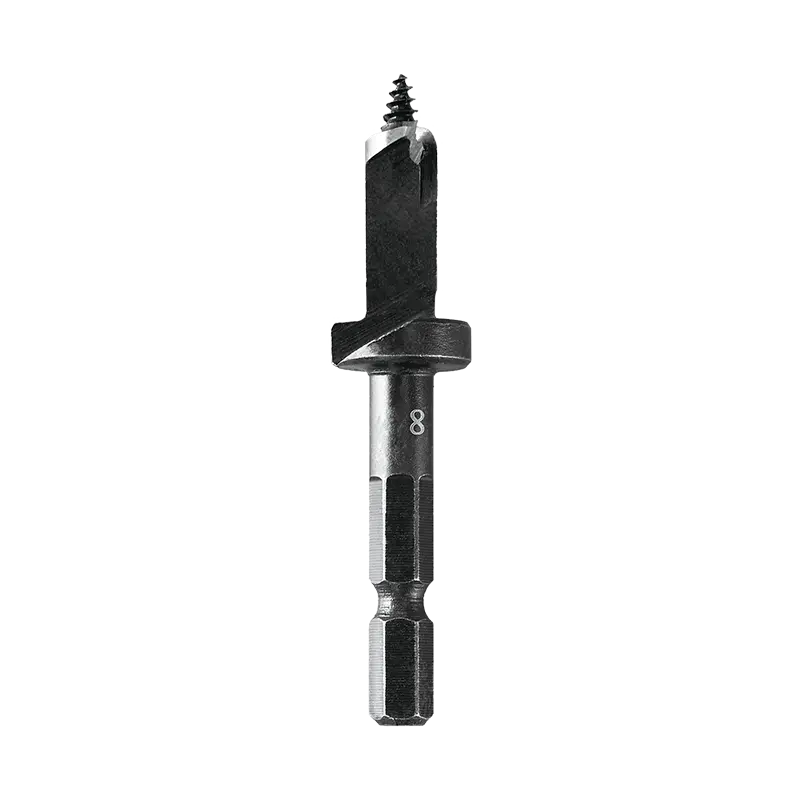
No single drill bit for wood excels in every task. The table below summarizes the most important woodworking drill bit types based on cutting action, hole quality, and typical diameter range. When you see a circular drill bit for wood, it’s usually a hole saw or a Forstner bit—both create clean, flat-bottomed or through holes but serve distinct purposes.
| Bit Type | Cutting Action | Hole Quality | Typical Diameter Range |
|---|---|---|---|
| Brad-Point | Spur-guided shearing | Excellent, no splintering | 1/8″ – 1/2″ |
| Forstner Bit | Rim-guided scooping | Ultra-smooth, flat-bottomed | 1/4″ – 2-1/8″ |
| Spade (Paddle) Bit | Fast scraping | Rough, tear-out possible | 1/4″ – 1-1/2″ |
| Auger Bit | Screw-tip pulling, deep flutes | Clean in deep holes | 1/4″ – 1″ |
| Hole Saw | Peripheral cutting teeth | Good, needs clearing | 3/4″ – 6″ |
For clean countersinks and screw pilots, consider tapered drill tools for wood with integrated countersinks. In high-volume production, solid carbide twist bits with reinforced web design last up to 10 times longer in abrasive materials like MDF. And when you ask what are good drill bits for hardwood, the answer is almost always brad-point bits made from high-speed steel (HSS) or carbide, as they hold a crisp edge longer and resist burning.
The difference between wood drill bit and metal is defined by tip geometry, heat tolerance, and cutting speed. A metal bit—often identified by a 135° split point—is optimized to cut hardened steel by crushing and shearing under high pressure. It typically has a thicker web and shallower flutes that are not designed to clear stringy wood fibers. When you try a metal drill bit vs wood on oak, the bit’s blunt tip walks across the grain, creating an oversized, rough hole and often burning the wood. Data from spindle-moulder tests show that using a typical drill bit for metal vs wood on pine results in a 40% larger entry splinter zone and a hole diameter that deviates by up to 0.3 mm from the nominal size.
The wood bit vs metal bit distinction also involves speed: wood bits are designed to run at higher RPMs (around 1,500–3,000 RPM for a 1/4″ bit in hardwood) because their sharp points generate less friction. Metal bits, conversely, demand slower speeds (400–1,000 RPM) and cutting fluid to survive. Visually, a difference between metal and wood drill bit is easy to spot: hold the bit tip-up. A wood bit has those unmistakable outer spurs and a long central point, while a metal bit looks like a steep, symmetric cone. Asking what does a wood drill bit look like vs a metal one? Wood bit = small center pin + sharp side cutters. Metal bit = plain cone, often black oxide or gold coated for heat resistance.
The masonry bit vs wood bit comparison is often muddied by multi-material bit marketing, but a genuine wood drill bit vs masonry drill bit couldn’t be more different. A masonry bit terminates in a wide, flat carbide insert that resembles a chisel. When you engage a hammer drill, this insert pounds and crushes brittle material. It does not slice fibers. If you use a masonry drill bit vs wood, the blunt tip pulverizes the wood cells, resulting in a charred, splintered hole that is far from the intended diameter. In controlled workshop tests, a masonry bit bored into pine leaves a hole with 2–3 times the expected surface roughness (Ra value) compared to a brad-point bit.
You might have bits labeled “multi-material” that look somewhat similar, but a dedicated wood bit has neither the carbide insert nor the extreme hardness needed for brick. If you’re selecting drill tools for wood from a mixed set, remember: a sharp point with lateral cutting edges = wood; a shovel-shaped carbide plate = masonry. The masonry bit vs wood bit rule is absolute for quality results.
Standard wood drill bit sizes range from a micro 1/16″ (1.6 mm) for pilot holes up to massive 2-1/8″ (54 mm) Forstner bits for concealed hinges. The most used diameters in woodworking shops cluster around 1/8″, 3/16″, 1/4″, 5/16″, and 3/8″—these cover the majority of clearance and pilot holes for #6 to #10 wood screws. When you see a circular drill bit for wood like a hole saw, diameters start at 3/4″ and go up to 6″ for downlight installations. Below is a quick reference for screw pilot holes in softwood and hardwood, assuming a typical taper bit or straight bit with countersink.
For dowel joinery, high-quality brad-point bits in fractional sizes by 1/64″ increments ensure a press-fit tolerance within 0.001″. Always match the bit diameter to the dowel exactly: a 3/8″ dowel requires a 3/8″ bit, and no larger, to maintain joint strength. If your carpentry tools drill bit collection feels incomplete, start with a 29-piece brad-point set from 1/16″ to 1/2″ by 1/64ths; it handles 95% of furniture tasks.
Even the finest bits for drilling wood can tear out if used incorrectly. Maintain a steady, moderate feed pressure—just enough to let the bit’s geometry do the work. In hard maple, a feed rate of 0.005–0.010 inches per revolution combined with 2,000 RPM for a 1/4″ bit yields crisp entry and exit holes. Backing the workpiece with a sacrificial board is a proven technique that reduces exit blowout by over 80%, according to woodworking school tests. When drilling deep holes with an auger or a wood twist drill bit, withdraw the bit several times to clear chips; clogged flutes generate heat that can temper the bit and char the hole wall.
If your drill bit for wood starts leaving fuzzy holes, it’s time to resharpen. Brad points can be touched up with a fine diamond paddle, focusing on the inner faces of the spurs. A well-maintained set of what are good drill bits—meaning high-speed steel brad-point and Forstner bits—will outlast cheap carbon steel bits by a factor of five, maintaining cutting efficiency across hundreds of holes.
I. Introduction: Solving the "Impossible" Task The phrase "fitting a square peg into a round hole" is a universal symbol...
READ MOREMetalworking has always been a cornerstone of industrial development, shaping everything from automotive components to a...
READ MORE1. What Are Waterpump Pliers? – The Flexible “All-Rounder” Tool In modern industrial manufacturing and daily maintenance...
READ MORESelecting the appropriate industrial cutting tools is a critical decision that directly impacts manufacturing efficiency...
READ MORE
+86-573-84611229

+86-573-84611518


NO.35 Yucao Road, Ganyao Town, Jiashan City, Zhejiang Province, China
