

 中文简体
中文简体 English
 русский
 Inquiry
Don't hesitate to send a message
I. Introduction: Solving the "Impossible" Task The phrase "fitting a square peg into a round hole" is a universal symbol...
READ MOREDrill bit shank types decide which machines a bit can physically enter, how much hammer energy reaches the carbide, and whether the cutting edge runs true at 1,500 rpm. Get the shank wrong and nothing else about the bit matters. What follows covers the shank families that appear on real purchase orders, the nominal dimensions behind them, and the selection rules that keep a container from being rejected at goods-in.
Content
The shank is the driven end of the bit: the section that enters the chuck, receives torque and hammer force from the machine, and keeps the cutting head on axis.
Drill bit shank types are defined by three properties: the geometry of the driven end, its nominal size in millimetres, and the retention system that locks it into one class of chuck.
A straight shank is gripped by friction from three jaws. Its torque capacity depends on clamping force, and clamping force falls away as the shank becomes oily, polished or worn. An SDS shank works on a different principle: two open grooves and two closed grooves let the bit slide axially while the chuck locks rotation, so the piston can hammer the bit without the operator leaning into the tool. That axial freedom is why SDS bits cannot be swapped into a three-jaw chuck even when the carbide tip looks identical to a round-shank version.
Retention is the third property, and it is the one buyers notice last. A quarter-inch hex bit inside a quick-change holder is held by a spring clip and a ball detent; the same bit in a plain magnetic holder is held by magnet strength alone. The basic concepts of drilling make the consequence obvious: every loose interface converts motor torque into heat and noise instead of hole depth.
Nine shank families cover nearly everything sold commercially, and each one locks a buyer into a defined set of machines and bit diameters. The table below uses nominal metric sizes, because that is how they appear on drawings, inspection reports and customs paperwork.
| Shank type | Nominal size | Machine or chuck | Common bit range | Retention |
| Straight round shank | 3 to 13 mm | Three-jaw keyed or keyless chuck | 1 to 13 mm | Jaw friction |
| Reduced shank | 12.7 mm | Three-jaw chuck with 13 mm capacity | 13 to 38 mm | Jaw friction |
| Triangle shank | 3 to 13 mm, three flats | Three-jaw chuck | 3 to 13 mm | Jaw friction, no rotation slip |
| Quarter-inch hex | 6.35 mm across flats | Quick-change holder, impact driver | 2 to 12 mm | Spring clip and detent |
| Large hex | 19 mm or 22 mm | Heavy rotary hammer, core drill | 25 to 150 mm | Locking collar |
| SDS-Plus | 10 mm, four grooves | Rotary hammer, 2 to 4 J | 4 to 26 mm | Sliding lock, axial free |
| SDS-Max | 18 mm, four grooves | Rotary hammer, 5 to 18 J | 12 to 52 mm | Sliding lock, axial free |
| Spline drive | 16 mm body, six splines | Older rotary hammers | 12 to 45 mm | Spline engagement |
| Morse taper | MT1 to MT6 | Drill press, lathe tailstock | 3 to 75 mm | Taper friction |
| Threaded shank | M16 or 1/2 in | Diamond core drill | 25 to 350 mm | Thread lock |
Two hex standards share the same 6.35 mm across-flats dimension, and confusing them is a recurring sourcing error. DIN 3126 C 6.3 has a plain hex body; DIN 3126 E 6.3 adds a retaining groove for locking quick-change holders. A C 6.3 bit can drop out of a locking holder under vibration, while an E 6.3 bit may not seat fully in a simple magnetic holder. Specify both the size and the standard, never one without the other.
Straight shanks win on accuracy and unit cost; hex shanks win on changeover speed. The deciding question is how many times the bit will be swapped during a shift, and how tight the hole tolerance has to be.
Clamped by three jaws and ground in 0.5 mm steps from 1 mm upward, this is the lowest cost per bit in almost every catalogue.
A 6.35 mm hex body that drops into a quick-change holder or an impact driver, built for one-handed work at height.
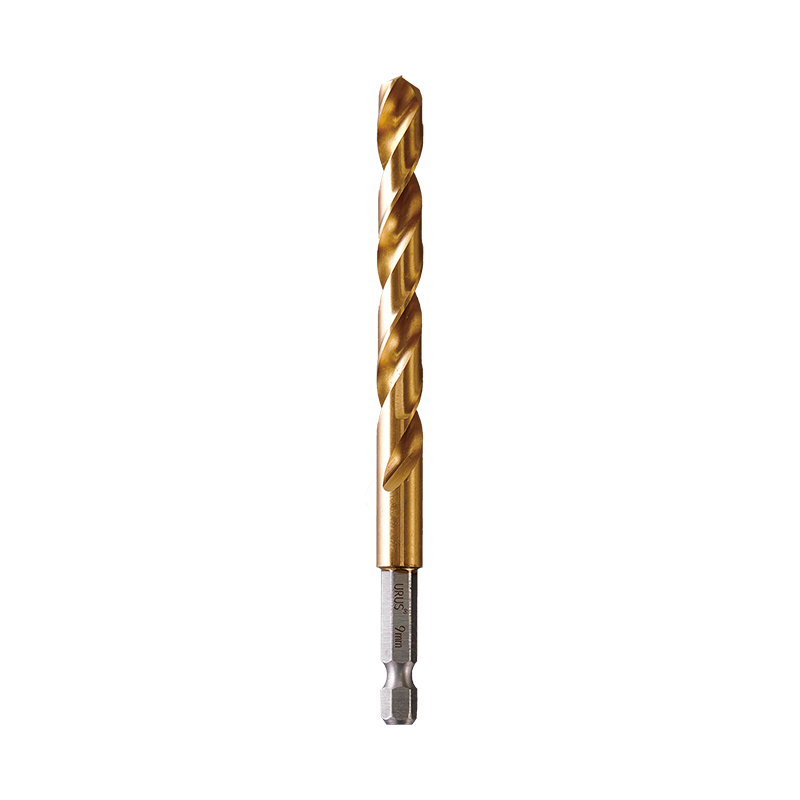 Custom Split Point Metal Drill Bits for 1/4-Inch Quick ChucksFor quick-change metal drilling, these split point bits offer multiple finishes, shank options, and L50, L70, DIN338, and DIN340 size series.View Product →
Metal drilling shows where the trade-off bites. A split point tip that starts cutting without a pilot hole still needs a stable shank to hold its geometry over hundreds of holes, and a straight round shank in a good chuck delivers that stability at a lower price. Hex shanks earn their place in maintenance and installation work, where speed matters more than hole position.
SDS-Plus, SDS-Max and spline are three separate hammer standards, and no adapter turns a light rotary hammer into a machine that drives SDS-Max bits at full energy.
The 10 mm SDS-Plus shank matches hammers in the 2 to 4 joule class, the machines found on most service vans. The 18 mm SDS-Max shank matches hammers from 5 to 18 joules and carries core bits up to roughly 150 mm. Spline drive, built on a 16 mm body with six splines, survives mainly in repair fleets and older equipment inventories. Attempting to file or grind a shank to fit a different chuck destroys the heat treatment, voids the warranty and creates a genuine safety risk at hammer speed.
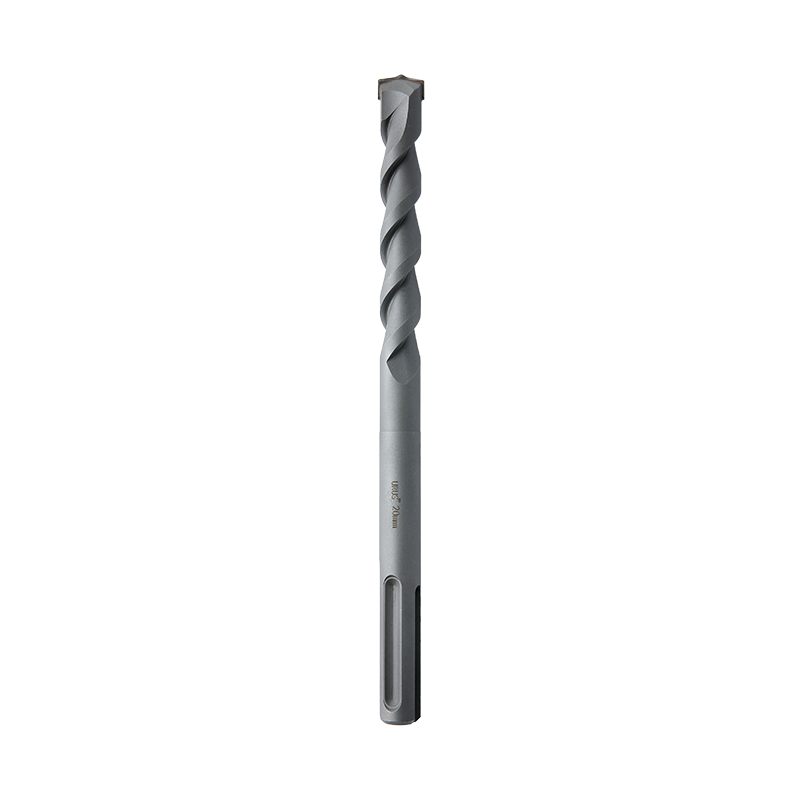 Custom SDS Hammer Drill Bits for Concrete, Brick, and StoneFor concrete and masonry drilling, these SDS hammer drill bits offer carbide tips, chrome-vanadium steel blades, and multiple lengths.View Product →
For concrete work between 6 mm and 26 mm, SDS-Plus remains the correct specification on cost, weight and energy efficiency. Above that band, the shank standard has to change before any other decision is made.
Each shank standard carries a practical diameter ceiling, and the ceiling is set by torque transfer and hammer energy rather than by the strength of the bit body.
Run-out is the second number worth tracking. In production checks, a three-jaw chuck holding a straight round shank usually measures 0.05 to 0.15 mm at the tip, a quick-change hex holder measures 0.10 to 0.30 mm, and an SDS chuck measures 0.30 to 0.80 mm on a 150 mm bit. Those figures are acceptable for hammer work and unacceptable for precision metal drilling, which is why the shank standard should be chosen from the operation, not from the machine the buyer already owns.
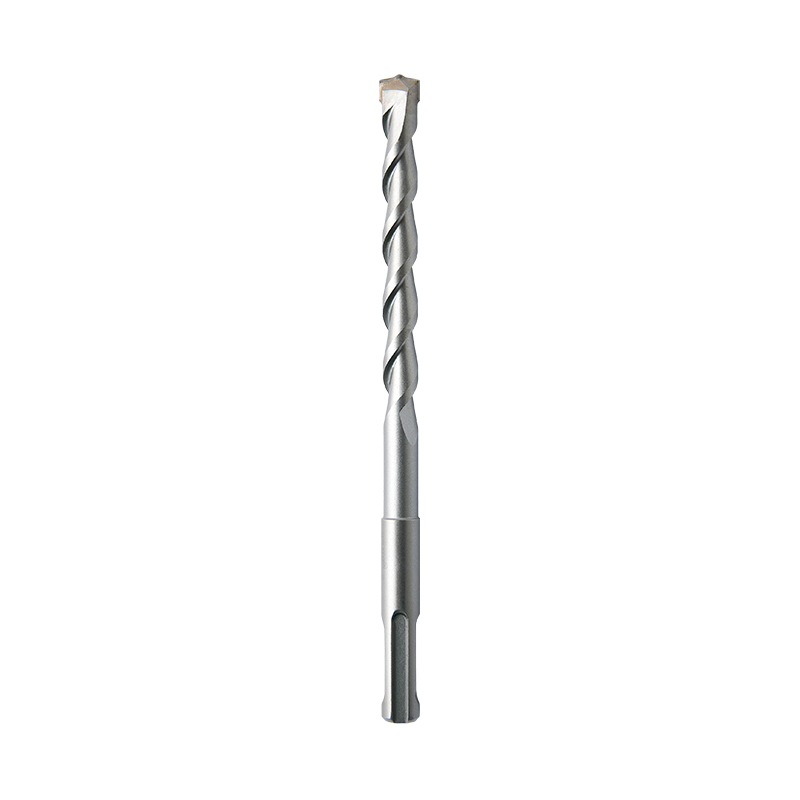 Custom SDS-Max Hammer Drill Bits for Concrete and MasonryFor large-diameter concrete work, these SDS-Max masonry drill bits offer 18 mm shank, carbide tip options, and 10 mm to 40 mm diameters.View Product →
Large diameter concrete work is the clearest case: a 12 mm hole in reinforced concrete needs percussive energy above roughly 2 joules, so a quarter-inch hex system has no realistic path into that application no matter how good the carbide is.
Adapters change the interface, never the capability of the machine. Every adapter in the chain adds run-out, removes energy and creates one more joint that can loosen under vibration.
No. The 10 mm grooved shank will not seat in a three-jaw chuck, and adapters that convert SDS-Plus to a round or hex shank are intended for light duty only. A rotary hammer is the correct host for any SDS bit.
The straight round shank remains the highest volume shank type worldwide because it fits the three-jaw chuck found on almost every corded and cordless drill. Quarter-inch hex is the fastest growing type, driven by impact drivers and quick-change holders.
Only above roughly 26 mm in hole diameter, or when the machine delivers more than 5 joules. Below that band, SDS-Max adds weight, cost and run-out with no gain in drilling speed.
No. Split point, brad point, pilot point and multi-cutter descriptions refer to the cutting end and are independent of the shank. The same carbide tip design can be pressed onto a straight shank or an SDS shank.
I. Introduction: Solving the "Impossible" Task The phrase "fitting a square peg into a round hole" is a universal symbol...
READ MOREMetalworking has always been a cornerstone of industrial development, shaping everything from automotive components to a...
READ MORE1. What Are Waterpump Pliers? – The Flexible “All-Rounder” Tool In modern industrial manufacturing and daily maintenance...
READ MORESelecting the appropriate industrial cutting tools is a critical decision that directly impacts manufacturing efficiency...
READ MORE
+86-573-84611229

+86-573-84611518


NO.35 Yucao Road, Ganyao Town, Jiashan City, Zhejiang Province, China
