

 中文简体
中文简体 English
 русский
 Inquiry
Don't hesitate to send a message
I. Introduction: Solving the "Impossible" Task The phrase "fitting a square peg into a round hole" is a universal symbol...
READ MOREA cabinet shop drilling forty 3/8 inch shelf-pin holes in white oak will get the job done in about eight minutes with a spade bit. Roughly 10% of those holes carry tear-out, and every one shows a center-point scar. Replacing the spade bit with a forstner bit eliminates the tear-out and the scar, but the bit turns slower, demands more torque, and costs two to three times more. The forstner vs spade bit decision in any shop comes down to hole location, material direction, and whether rework is built into your process.
Content
The forstner bit is the only standard woodworking bit that produces a completely flat hole bottom with a clean circular rim. Its center point locates the cut, the rim cutter scores the wood fibers before any chip is removed, and the inner blade shaves the material out. That sequence protects the hole edge and leaves the bottom flat. A spade bit's flat blade cannot match this. Its cutting edges wedge through the grain at the same time, especially on the exit side, where the bit splinters the wood instead of slicing it.
Because the forstner bit makes a blind cut, the chips have no easy exit. In deep holes, the chips pack into the cutter area and slow the bit. That is why a pecking motion is recommended. The spade bit has an open flute design that throws chips out on its own, which is why it feels faster in a through-hole.
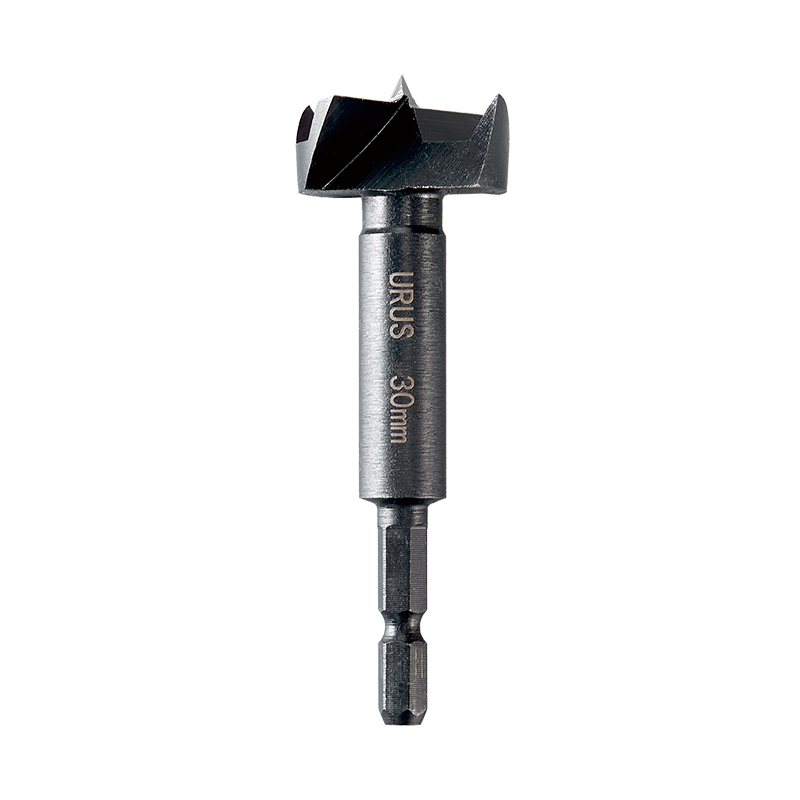 Brad Point Forstner Bit for Clean Wood DrillingThis bit delivers clean holes without rework on visible or structural faces. Its broad point positions easily, making it ideal for finished surfaces in cork, hardwood, and MDF.View Product →
The forstner bit costs less per finished hole in any run that requires a finished surface, even though its purchase price is two to three times higher. A 3/4 inch spade bit retails for about $5, and a 3/4 inch forstner bit for about $14. On a job of 500 holes, the bit price gap is under $50. If 10% of spade holes need re-drilling or sanding, and each rejection takes 15 minutes of shop labor at $60 per hour, the rework cost is over $450. That math flips the decision.
| Cost item | Forstner bit | Spade bit |
| Bit cost for the run | $14 to $25 | $5 to $10 |
| Rejected holes at a 10% rate | 0 to 5 | 50 |
| Labor cost for rework | Near $0 | $450 |
| Total cost for the run | $14 to $25 | $455 to $460 |
Rework is what a production plan should attack. What you should know about forstner bits adds detail on geometry limits and field sharpening for shops that run high volumes. A forstner bit in high-carbon steel can be resharpened between runs, extending service life far beyond a spade bit that is thrown away.
For framing, utility runs, or any hole that will never be seen, the spade bit is the right tool. In a 2x4, a 1/2 inch spade bit drills a clean enough through-hole in under two seconds, ejects its own chips, and costs less than $5. Nothing about a forstner bit is faster in that context.
Spade bits also have a 1/4 inch shank, which can vibrate at larger diameters. When you push a 1 inch spade bit through a knot, the shank can chatter and swing the bit off center. A center punch and a slow feed prevent most of that, but the cut width becomes less predictable as the diameter grows.
Keep spade bits in the tool crib for these situations:
Torque demand, chip clearing, and RPM limits separate these two bits more than price does. The table below reflects standard operating ranges for 3/4 inch bits on a portable drill.
| Characteristic | Forstner bit | Spade bit |
| Hole bottom | Flat | Center point scar remains |
| Edge tear-out | Near zero | Occasional on exit |
| Chip ejection | Peck regularly | Self-ejecting |
| Torque demand | High | Low to moderate |
| Best RPM range | 600 to 1,200 | 1,500 to 2,500 |
| Max practical diameter | 3 in. or more | 1-1/2 in. |
| Typical production job | Hinge mortises, shelf pins | Rough through-holes |
Relative performance: forstner vs spade (3/4 in. bit)
If your customer sees the hole, or the hole sits in a structural joint, buy forstner bits. If the hole is hidden, buy spade bits. That one rule covers the vast majority of sourcing decisions. For the remaining edge cases, apply these five checks in order.
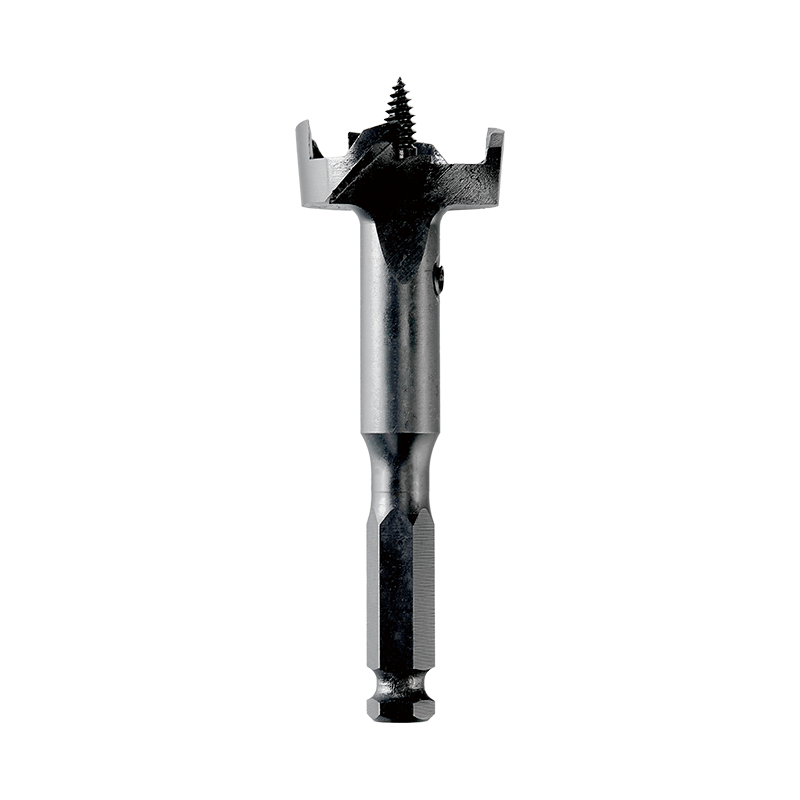 Screw Point Forstner Bit for Self-Feeding Production DrillingWith a self-feeding screw point and replaceable tooth tip, this bit boosts efficiency in high-repeat runs. It ensures steady cutting and rapid chip clearance in hardwoods and MDF.View Product →
For high-repeat production runs, a screw-point forstner bit feeds into the wood without a separate pilot hole, holds a steady cutting angle, and reduces chip-load variation. That matters when an operator drills hundreds of hinge locations in a single shift.
Purchase managers building a forstner bit assortment should size the set around the three diameters that cover their most common joints: a 1/4 inch shelf pin, a 3/8 inch hinge screw, and a 1/2 inch dowel. Adding a screw-point version for the production line gives a self-feeding option that reduces end-grain splitting.
Zhejiang URUS Tools Co., Ltd. manufactures both brad-point and screw-point forstner bits in an ISO 9001:2015 certified facility, and tests them in a TUV Rheinland cooperative laboratory. Buying from a manufacturer with in-house production and testing reduces supply risk for private-label and OEM programs.
A forstner bit produces a flat-bottomed hole with a clean circular edge. A spade bit cuts a rougher hole, leaves the center-point mark in the bottom, and can tear wood fibers on exit.
Yes, for most diameters up to about 1 inch. A forstner bit needs a drill with sufficient torque, especially above 3/4 inch. A spade bit works in any drill because it demands much less torque.
A good forstner bit can be resharpened several times because its rim cutter dulls slower than a spade edge. Spade bits are normally treated as disposable and not resharpened at all.
Yes, and plywood is where the rim cutter proves its value. It scores the veneer before cutting, so the top layer stays clean. A spade bit in plywood commonly blows out the top veneer.
I. Introduction: Solving the "Impossible" Task The phrase "fitting a square peg into a round hole" is a universal symbol...
READ MOREMetalworking has always been a cornerstone of industrial development, shaping everything from automotive components to a...
READ MORE1. What Are Waterpump Pliers? – The Flexible “All-Rounder” Tool In modern industrial manufacturing and daily maintenance...
READ MORESelecting the appropriate industrial cutting tools is a critical decision that directly impacts manufacturing efficiency...
READ MORE
+86-573-84611229

+86-573-84611518


NO.35 Yucao Road, Ganyao Town, Jiashan City, Zhejiang Province, China
