

 中文简体
 English
 русский
 Inquiry
Don't hesitate to send a message
I. Introduction: Solving the "Impossible" Task The phrase "fitting a square peg into a round hole" is a universal symbol...
READ MOREContent
Take a 3/16 inch twist drill to a piece of 304 stainless plate and watch what happens. The tip turns blue, smoke curls up, and inside a minute the cutting edge is rubbing instead of cutting. Nothing was wrong with the drill except this: past roughly 540 C, the carbides inside the steel body stop holding their hardness. To understand what a drill bit is made of is really to understand which base material is standing between you and that moment.
Every drill bit is two parts: the cutting edge and the body that carries it. The cutting edge comes from only four material families. Those are high-speed steel, cobalt-bearing high-speed steel, tungsten carbide in either solid or brazed form, and diamond abrasive. Carbon steel is a fifth and mostly historic option that now survives mainly in cheap woodworking bits.
A drill bit is a rotary cutting tool whose edge is made from hardened tool steel or tungsten carbide, chosen so that the edge is harder than the material being cut and stable at the temperature the cut generates.
That definition is why material selection follows the workpiece rather than the other way round. Timber charrs near 200 C. Concrete aggregate sits around 7 on the Mohs scale. Stainless steel pushes the edge past 600 C. Each condition points at a different base material, which is exactly why no single bit drills everything well.
Roughly eight out of ten drill bits sold worldwide are made from high-speed steel, and M2 is the grade doing most of that work. M2 is not a brand. It is an AISI tool steel classification, written as DIN 1.3343 in European catalogues.
A typical M2 melt, measured by weight, contains:
After hardening and double tempering, M2 lands between 62 and 65 HRC. That is hard enough for mild steel, aluminium, brass, plastics and most timber, and tough enough that the bit bends before it shatters when the drill grabs.
Surface finish does not change any of this. A black oxide bit carries a layer of iron oxide under ten microns thick. It holds cutting fluid and stops chips welding to the edge. Grind the coating off and the steel underneath is identical.
High-speed steel earns its hardness from heat treatment, not from chemistry. Take the tip past roughly 600 C and it turns into ordinary steel. The colour change is the only warning you get.
Split-point geometry is the most common shape you will actually buy. The two main cutting edges are ground into four facets meeting at 135 degrees. On plate under 10 mm it stops the point wandering, and it needs less feed pressure than a 118 degree point because the chisel edge is shorter.
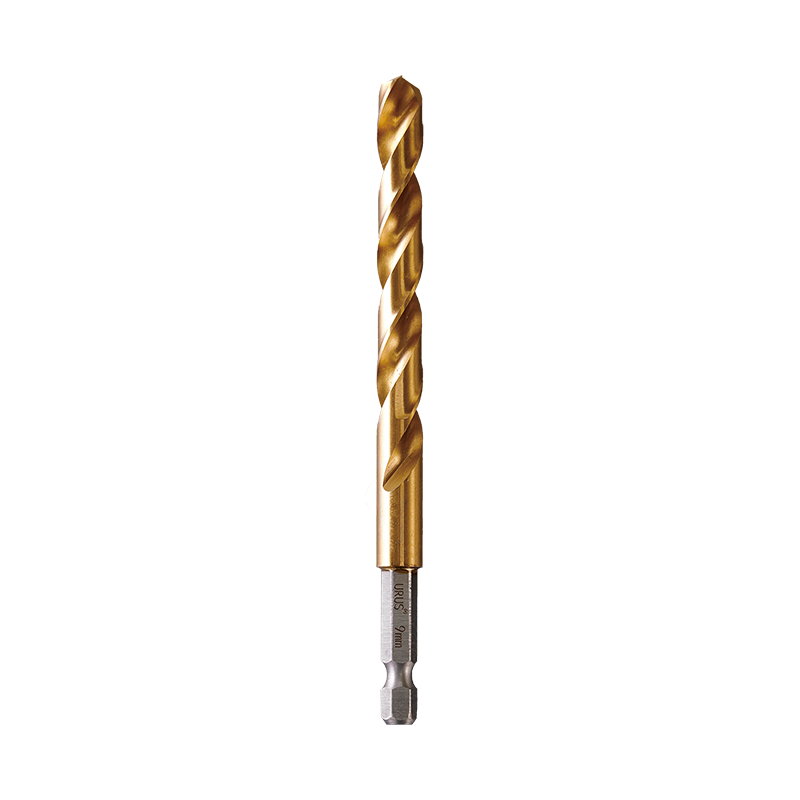 Split Point Metal Drill Bit for 1/4-Inch Quick Shank ChucksA metal drilling bit with split-point geometry, available across L50, L70, DIN338, and DIN340 dimensions; useful when reviewing 135-degree point options and cobalt HSS grades.View Product →
Cobalt is not used to build the body of a drill bit. It is an alloying element melted into the high-speed steel, at five to eight percent by weight. M35 carries around 5 percent and M42 carries around 8 percent, and those are the two names you will see printed on packaging.
What cobalt does is slow the coarsening of carbides at temperature. Tungsten carbide particles in a steel matrix want to clump and grow, and once they grow the edge goes soft. Cobalt retards that process and pushes the usable edge temperature upwards. The measured gain in hot hardness looks roughly like this.
You cannot tell a cobalt bit from a non-cobalt bit by looking at it. The same factory may finish M2, M35 and M42 with identical black oxide, out of the same bin. Short of a printed steel grade on the packaging, the only signal left is price and how long the edge survives stainless.
Cuts 304 stainless and mild steel at moderate speed. Cheaper per bit and the usual choice for maintenance work and light fabrication.
Holds an edge noticeably longer in titanium, Inconel and alloys above 35 HRC. Costs more and is brittle enough that a hand drill can chip it on breakout.
Tungsten carbide is not steel at all. It is powder metallurgy. Sub-micron tungsten carbide grains are bonded with cobalt or nickel and sintered near 1400 C into a solid blank. A typical WC-Co grade runs 6 to 12 percent cobalt binder by weight.
Hardness lands around 1400 to 1600 HV, which is about 90 on the HRA scale and well past anything a file can touch. That hardness is what lets it cut concrete aggregate that would simply polish an HSS edge flat.
It arrives in two shapes. Solid carbide means the entire drill is sintered, which is standard for 0.3 mm micro-holes in printed circuit boards and for CNC machining centres. Carbide-tipped means a small sintered insert is brazed onto a steel shank, which is the construction used for masonry and hammer work.
SDS-plus and SDS-max hammer bits are almost all brazed. A three-cutter carbide tip is welded onto a grooved steel shank, and the three cutting edges split the hammer energy across three contact points instead of two, which keeps the hole round and reduces binding in reinforced concrete.
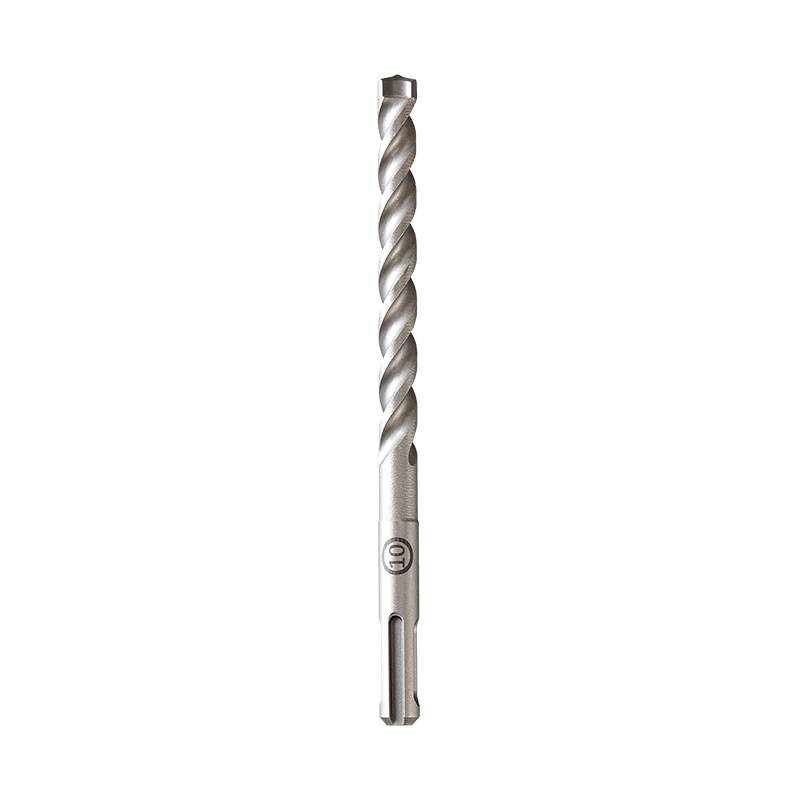 SDS-3-Cutter Carbide-Tipped Hammer Bit for Masonry DrillingA three-cutter carbide-tipped masonry hammer bit with three-flute dust removal, sized 3.45–18 mm; useful when comparing brazed SDS bits for brick, concrete, and stone.View Product →
Brazing is the weak point of every carbide-tipped bit. Silver and brass brazing alloys melt between 600 C and 700 C. Glow a masonry bit red and the tip drops off, leaving a perfectly good steel shank with nothing on the end of it.
PVD coatings on drill bits are thin films, usually 1 to 4 microns, which is gone after roughly 30 holes in steel at normal feed rates. Titanium nitride and titanium aluminium nitride are the two you meet most often, and they work by lowering friction and reducing built-up edge rather than by hardening the steel beneath.
A titanium-coated M2 bit and a plain M2 bit have the same hardness. The coating changes how the chip slides, not how hard the edge is.
Colour is a poor test here, which is the trap most buyers fall into. An amber or gold edge is often TiN, but a dark blue-grey edge may simply be steam oxide, and a genuine cobalt steel bit can carry no colour at all after a bright finish. Read the printed steel grade instead of the shade.
Wood charrs at around 200 C, which is nowhere near the point where a steel body would anneal, so a woodworking bit has no need for cobalt or tungsten carbide. It is made from carbon steel or plain M2, and the geometry carries the performance instead.
A brad-point wood bit has three working features that matter:
Remove the spurs and the hole tears. That is why woodworking bits are judged on their grind, not on their alloy content.
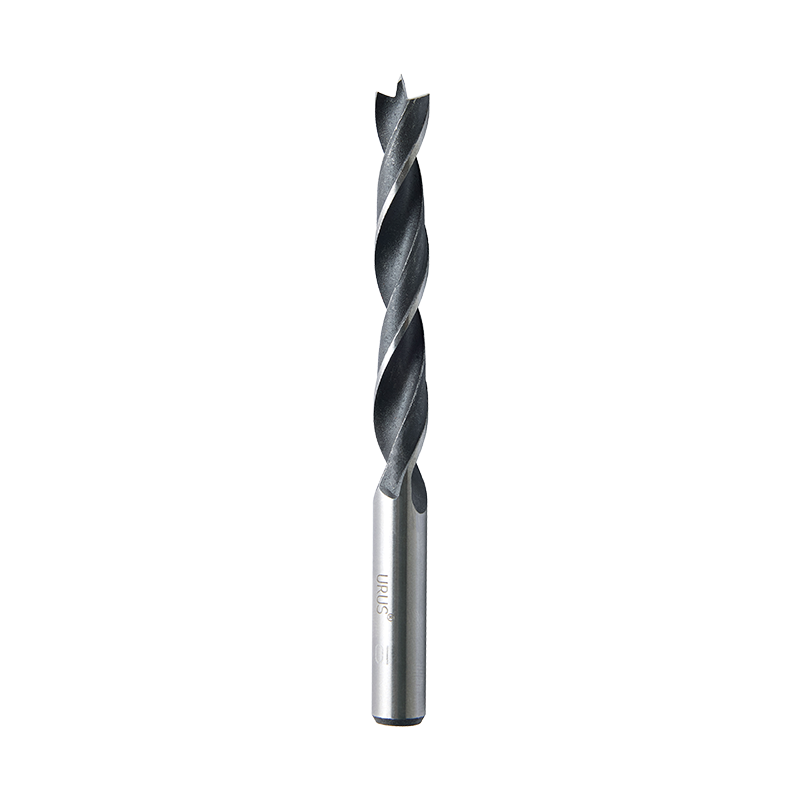 Standard Brad Point Wood Drill Bit with Round ShankA carbon steel brad point bit with precision center point and round shank, in 3–30 mm diameters; suited to wood drilling where tear-out matters.View Product →
Woodworking bits rarely use a carbide edge because carbide is brittle. Timber is soft, but one embedded nail is enough to chip a sintered tip back to useless.
Colour narrows the field, but a file settles the question. A 60 HRC file bites into any high-speed steel grade, whether that is M2, M35 or M42, and skates across tungsten carbide without leaving a mark.
| What you see | Most likely material | How to confirm it |
| Plain grey metal, no coating, normal weight | M2 high-speed steel | A file bites and leaves a bright scratch |
| Black or dark blue finish | Black oxide over HSS or carbon steel | A file bites; carbon steel scratches more easily and brightens faster |
| Gold or amber finish | TiN coating, usually over M2 | The file scrapes coating off and exposes grey steel underneath |
| Dark, non-reflective tip visibly thicker than the shank | Brazed tungsten carbide tip | The file skates; the tip is far harder than the body below it |
| Edge feels gritty, like fine sandpaper | Electroplated diamond abrasive | The file skates and the edge looks like embedded grains, not a ground edge |
The file test is reliable enough because it cannot be fooled by alloying. M35 and M42 are close enough to M2 that a file will not separate them, so on a cobalt question only the printed steel grade gives you an answer.
If a bit comes with no printed steel grade, assume M2. Cobalt steel costs real money, and no factory quietly puts it into an unlabelled bit.
No. An HSS bit is steel, but high-speed steel is an alloy tool steel in which roughly 15 to 18 percent of the weight is tungsten, molybdenum, chromium and vanadium. A tungsten carbide bit contains no steel in its cutting structure at all; it is sintered tungsten carbide grains held together by a cobalt binder.
Yes, but less than the name suggests. M35 contains about 5 percent cobalt and M42 about 8 percent, with the rest being iron and carbides. Cobalt does not form a separate layer. It dissolves into the matrix and slows carbide coarsening as the edge heats up.
A solid carbide bit can, and it is the standard choice for cast iron, hardened steel above 45 HRC and aluminium production work. A brazed carbide tip cannot. That tip is brittle, it chips easily in interrupted cuts, and its braze joint fails near 650 C, which is below the edge temperature a steel cut generates.
No. An amber tint can also come from steam oxide treatment, and a cobalt steel bit may show no colour at all. TiN films run 1 to 4 microns thick and are only visible as a colour shift, not as a distinct layer. Check the printed steel grade rather than the shade.
I. Introduction: Solving the "Impossible" Task The phrase "fitting a square peg into a round hole" is a universal symbol...
READ MOREMetalworking has always been a cornerstone of industrial development, shaping everything from automotive components to a...
READ MORE1. What Are Waterpump Pliers? – The Flexible “All-Rounder” Tool In modern industrial manufacturing and daily maintenance...
READ MORESelecting the appropriate industrial cutting tools is a critical decision that directly impacts manufacturing efficiency...
READ MORE
+86-573-84611229

+86-573-84611518


NO.35 Yucao Road, Ganyao Town, Jiashan City, Zhejiang Province, China
