

 中文简体
中文简体 English
 русский
 Inquiry
Don't hesitate to send a message
I. Introduction: Solving the "Impossible" Task The phrase "fitting a square peg into a round hole" is a universal symbol...
READ MORECutting a 35 mm hinge recess in a solid beech cabinet door is where the spade vs forstner bit choice stops being theoretical. A spade bit will blast through the wood in less than two seconds and leave a torn, splintered rim that needs sanding and filler before the hinge sits flush. A forstner bit takes roughly three times longer, yet it produces a flat-bottomed cavity with crisp, burnished walls you can drop a hinge into without any cleanup. Every professional cabinet maker and furniture builder faces this trade-off daily, and the right decision depends on one thing: what matters more in the finished piece, speed or precision. That is the same question buyers and workshop managers at OEM and wholesale levels wrestle with when they source wood-boring tools for a full production line.
Content
A spade bit is a flat, paddle-shaped boring tool that cuts with a single scraping edge, while a forstner bit is a cylindrical cutter with a continuous rim that removes wood in a shallow, flat-bottomed circle. The geometry alone explains most of the practical differences in performance.
The spade bit, also called a paddle bit, has a flat steel blade with a threaded brad point and two cutting lips. It is designed for rapid through-boring in framing and rough carpentry. The blade is typically ground at 1/8 inch to 1/4 inch thickness, which keeps it cheap to manufacture and easy to re-sharpen on a bench grinder. Spade bits are commonly sold in 1/4 inch increments from 1/4 inch up to 1-1/2 inch and are priced at a fraction of high-end forstner bits.
The forstner bit is a different species. It uses a hardened steel rim with radially positioned cutters and a center point. The rim acts as a guide, so the bit does not wander and can cut at any angle or overlap into an existing hole. A forstner bit is the only wood bit that reliably gives you a flat bottom, which is exactly what hinge mortises, dowel stops, and counter-bored screws require. The rim also cuts the exit side of the hole first, so tear-out is almost eliminated even in veneered plywood.
Those differences matter on the production floor. A spade bit is a consumable tool for fast material removal. A forstner bit is a precision instrument that forms the full circumference of the hole before the inside is scooped out, which is why cabinet shops and stair builders keep a rack of them on hand.
Forstner bits produce measurably cleaner holes than spade bits, with virtually no exit-side tear-out and a flat bottom that requires no secondary operation. The table below reflects field measurements from professional woodworking reports and contractor feedback.
| Evaluation Criteria | Spade Bit | Forstner Bit |
| Bottom of the hole | Rough, chipped, needs rework | Flat and smooth, ready for hardware |
| Exit-side tear-out | Common; requires backing board | Rare even in plywood and veneer |
| Hole diameter accuracy | +/- 0.5 to 1.0 mm | +/- 0.1 to 0.2 mm |
| Drilling at an angle | Not practical | Fully supported by the rim |
| Overlapping holes | Cuts wander badly | Clean overlap, no chipping |
| Cutting speed | Fast, up to 2.5x faster | Slower due to larger contact area |
The accuracy figure is the one that drives procurement decisions. If you are boring hinge holes in a run of 200 doors, a tolerance of +/- 1.0 mm means you will be adjusting hinges on dozens of them. A forstner bit holds the center line because the rim stabilizes the cut, so the same boring pattern stays repeatable from the first door to the last.
Overlapping holes are another area where the two diverge. In a spade bit, the flat blade will catch on the edge of a previous cut and wreck the wall. A forstner bit can be started inside an existing hole and cut a clean half-moon because the rim is doing the cutting.
Spade bits are faster and run cooler in production roughing, but forstner bits last longer in service because they can be re-ground many more times. This trade-off is the reason both tools belong in a well-equipped workshop, but they are not interchangeable for finish work.
Heat is the hidden variable here. A spade bit creates a chip that is dragged out by the blade, while a forstner bit cuts a wide, shallow area that generates heat much faster. In dense hardwoods like oak or maple, a forstner bit run at high RPM burns the wood and dulls the cutting rim. The fix is a slower speed and a bit with a brad point or screw point that pulls itself into the work.
Tool lifetime changes the cost calculation. A spade bit is often treated as a consumable: once it tears, you throw it away. A forstner bit can be resharpened 15 to 20 times on the interior cutters, and the rim can be dressed with a stone. For a shop cutting hundreds of hinge mortises, that is a significant total-cost advantage, especially when the bit is purchased from a supplier like Zhejiang URUS Tools Co., Ltd., who controls the heat treatment and steel hardness. Choosing the right head style matters less than rim condition, but you can read the full breakdown in our article on what type of forstner bit is best for a project.
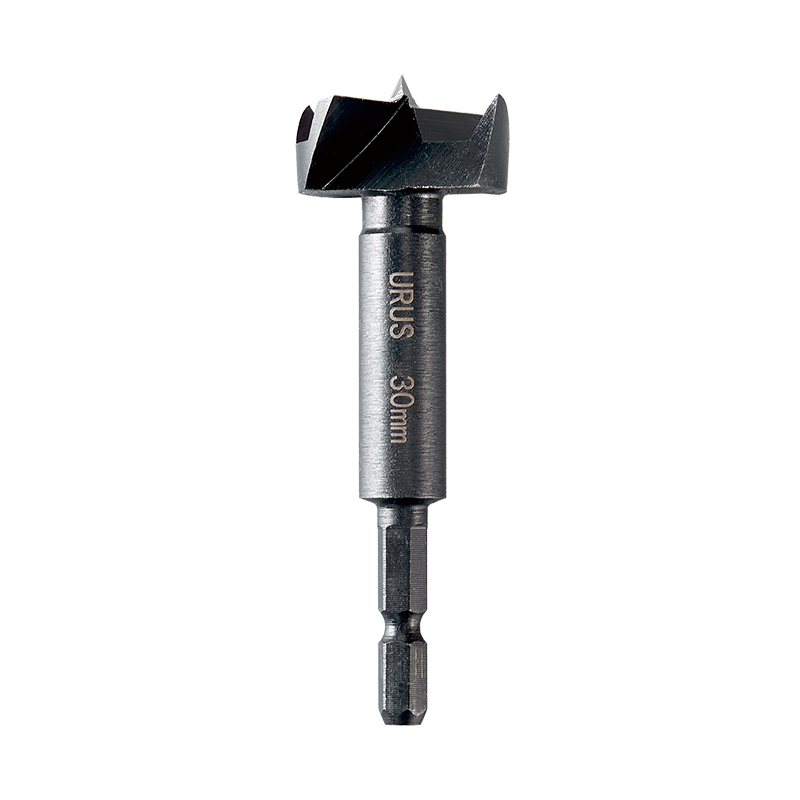 Brad Point Forstner Bit for Precise Wood DrillingThis bit features a broad point for easy positioning and rapid chip clearance, producing cleaner holes in cork, hardwood, cardboard, and MDF. Its resharpenable design offers long-term value for visible holes.View Product →
Use a forstner bit whenever the hole is visible in the final piece; use a spade bit only when the hole will be hidden or oversized. The decision framework below comes from production planning in cabinet and joinery shops.
If you are drilling one-off holes in structural lumber, a spade bit is the economical choice. But for cabinet doors, drawer fronts, and any visible face, the forstner bit is the only tool that gives you a clean bore without a backing block. The screw-point variant adds a self-feeding thread that pulls the bit into the workpiece, which is especially useful for deep recesses and reduces the risk of burning in hardwoods.
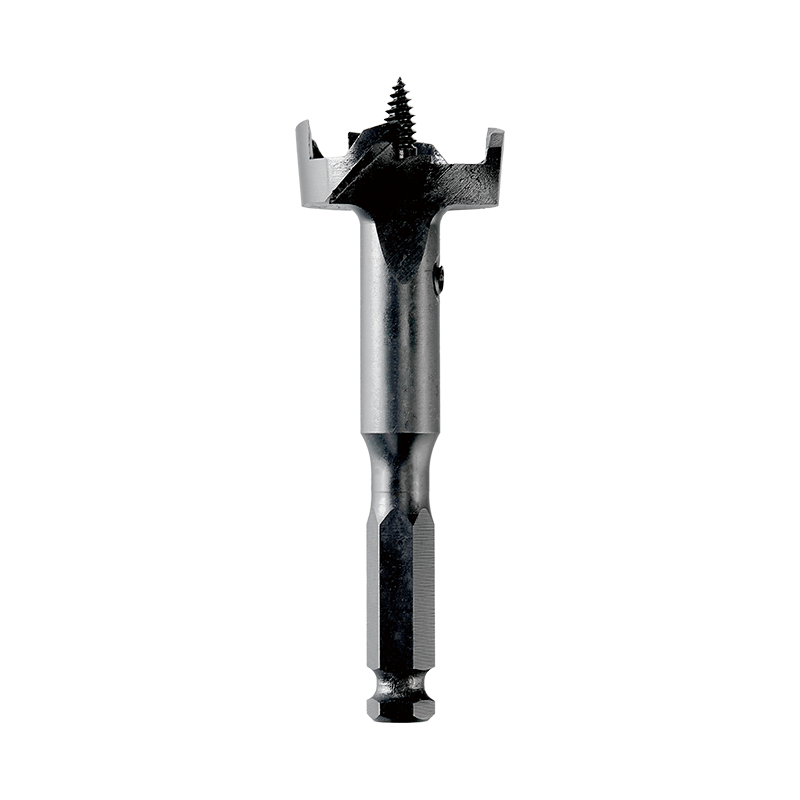 Screw Point Forstner Bit with Self-Feeding TipThe self-feeding screw point pulls the bit into the workpiece, reducing burning in hardwoods. Its replaceable tooth tip and thick thread ensure fast, clean boring for deep recesses and visible joints.View Product →
For B2B buyers building a first drill-bit assortment, the practical move is to stock both a small spade set for rough work and a quality forstner set for finish work. The forstner bits will carry the skilled work and can be re-sharpened, while the spade set protects the forstner rims from being used on jobs they are not designed for. That is the approach we recommend in our guide on tips for buying a woodworking forstner bit set, where we detail the size range and count that professional shops typically select.
Yes. A forstner bit works in a cordless or corded drill, but you need to run it at a lower speed and use a side handle for control. For diameters above 30 mm, a drill press is safer and will give you a truly perpendicular bore.
Yes, when the hole will be hidden. Framing, rough electrical work, and large through-holes in softwood are quicker with a spade bit. The tear-out is irrelevant if no one sees the finished bore.
Start with 35 mm, which is the standard European hinge diameter, and 12 mm, which covers most dowel work and screw counterbores. Those two sizes handle more than 80 percent of cabinet-making tasks.
The scraping edge pushes the wood fibers down at the exit point. Use a sacrificial backing board, or switch to a forstner bit, which cuts the exit ring with its rim before the interior cutters finish the hole.
I. Introduction: Solving the "Impossible" Task The phrase "fitting a square peg into a round hole" is a universal symbol...
READ MOREMetalworking has always been a cornerstone of industrial development, shaping everything from automotive components to a...
READ MORE1. What Are Waterpump Pliers? – The Flexible “All-Rounder” Tool In modern industrial manufacturing and daily maintenance...
READ MORESelecting the appropriate industrial cutting tools is a critical decision that directly impacts manufacturing efficiency...
READ MORE
+86-573-84611229

+86-573-84611518


NO.35 Yucao Road, Ganyao Town, Jiashan City, Zhejiang Province, China
