

 中文简体
 English
 русский
 Inquiry
Don't hesitate to send a message
I. Introduction: Solving the "Impossible" Task The phrase "fitting a square peg into a round hole" is a universal symbol...
READ MOREContent
Tungsten carbide holds its hardness to about 900 degrees Celsius, while high-speed steel grade M2 starts to soften at roughly 540 degrees Celsius. That 360-degree gap settles most carbide versus HSS tool life arguments before the first hole is drilled, because the carbide edge keeps cutting at temperatures where an HSS edge has already rounded over. What the gap does not settle is what happens when the spindle is loose, the drill is hand-held, or the annual hole count is too small to pay for a diamond regrind.
Tool life is the number of holes, or the minutes in cut, that a drill delivers between regrinds, and it is always measured against a wear limit rather than an operator's sense that the bit has gone dull.
Working definition
Tool life is the interval between two regrinds at a fixed wear criterion. ISO 3685 sets a 0.3 mm average flank wear land for carbide turning tools; drilling practice usually calls the cut at 0.15 to 0.25 mm of margin wear, because a 6 mm drill loses its diameter long before it loses its point.
The two materials also fail in opposite ways, and for a buyer that matters more than the headline multiplier. HSS wears gradually: flank wear spreads along the margin, thrust force climbs, hole diameter drifts, and the drill gives several hundred holes of warning. Carbide wears slowly and then fails in a single event.
A carbide drill that has cut 400 clean holes in 1045 steel can lose its corner on hole 401, and that single event defines its tool life.
Under a rigid setup with flooded coolant, a coated carbide drill lasts 3 to 10 times longer than an HSS drill in carbon steel and grey cast iron; the same carbide drill can lose half of that advantage to 0.05 mm of spindle runout that an HSS drill would absorb without complaint.
| Property | HSS (M2 / M42) | Carbide (K10 / P25) |
| Room-temperature hardness | 62 to 66 HRC | 1,400 to 1,800 HV |
| Hot hardness ceiling | 540 to 600 C | 800 to 1,000 C |
| Elastic modulus | About 210 GPa | About 600 GPa |
| Transverse rupture strength | 3,000 to 4,500 MPa | 1,500 to 2,500 MPa |
| Life in 1045 steel, rigid setup | 1.0 baseline | 3.0 to 10.0 |
| Dominant failure mode | Gradual flank wear | Chipping, thermal cracks |
| Regrinds per drill | 10 to 20 on aluminium oxide | 5 to 8 on diamond |
| Relative unit price, 6 mm | 1.0 | 4.0 to 8.0 |
Two rows drive most purchasing decisions: the life multiplier and the regrind count. A carbide drill costs four to eight times more and can be restored five to eight times, so the economics only work when each regrind returns roughly three times the holes of an HSS regrind.
The one-line summary: carbide wins on holes per edge, HSS wins on edges per dollar.
HSS wins tool life whenever the cut is interrupted, the drill is hand-held, or the edge has to be restored on a bench grinder, because HSS absorbs impact energy that fractures carbide.
HSS holds the advantage when
Carbide holds the advantage when
An HSS drill tells you it is dull. A carbide drill tells you it has already broken.
Coatings narrow the gap from the HSS side. A TiN or TiAlN coating on an M2 or M42 substrate typically returns two to three times the life of a black-oxide bit in mild steel at roughly 1.3 times the price, which is why coated HSS still fills most hand drills and maintenance kits. The metal drill range from Zhejiang URUS Tools Co., Ltd. covers pilot point, split point and turbomax point geometries, each ground for a different balance of centring accuracy and chip evacuation.
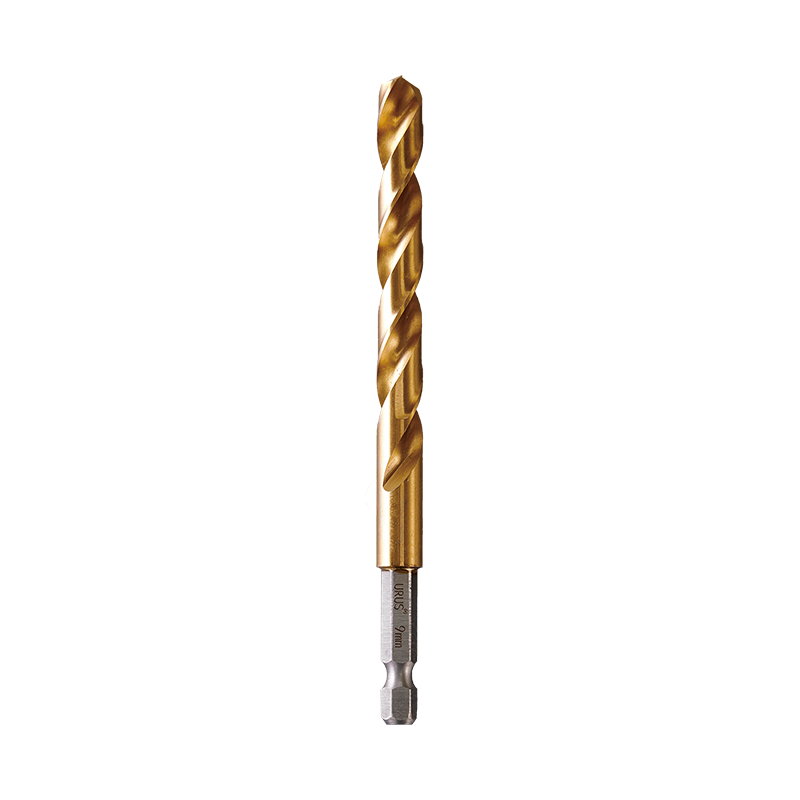 Split Point Metal Drill Bit for Quick-Shank ChucksA whole-body ground metal drill bit with split-point geometry, multiple finishes, and L50, L70, DIN338, or DIN340 size options for quick-shank chucks.View Product →
Carbide's advantage widens with abrasive content and cutting temperature: 7 to 9 times the life of HSS in grey cast iron and glass-fibre laminate, and no realistic HSS alternative at all in concrete.
Relative tool life, HSS = 1.0
Range midpoints from published drilling multipliers. Real values move with speed, feed, coolant and runout.
In masonry the comparison is not close. An SDS-plus hammer drill with a brazed carbide tip is the practical tool for concrete from C20/25 upward, because the tip survives impact that would flatten an HSS edge within a few centimetres of drilling. The braze joint and the 130-degree point spread the hammer load, and the tip can be reconditioned on a diamond wheel instead of being scrapped. Tip geometry has moved on since the first brazed inserts, and the next evolution in masonry drill bits covers how multi-cutter heads and new braze alloys changed life expectancy in reinforced concrete.
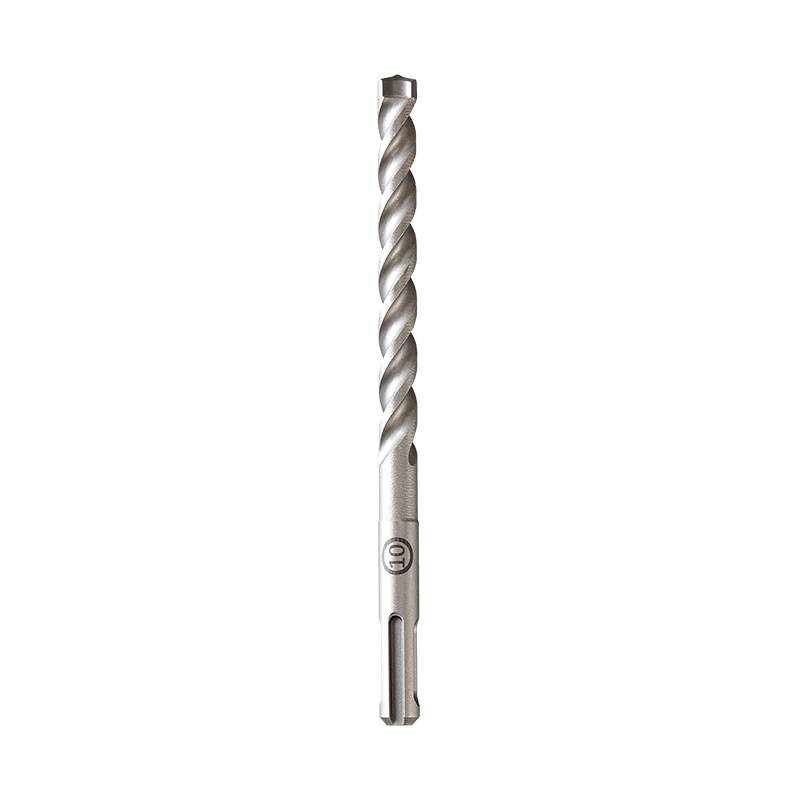 SDS-3-Cutter Carbide-Tipped Hammer Drill BitA masonry hammer bit with a three-flute design and carbide tip, offered in sizes from 3.45 mm to 18 mm for brick, concrete, and stone.View Product →
Cost per hole, not cost per drill, is the number that belongs in a purchasing decision, and at 4,000 holes a year the arithmetic usually flips the answer.
Worked example: a 6.5 mm drill, 4,000 holes a year in 1045 steel, a shop rate of 60 USD per hour. HSS at 6 USD with 12 regrinds at 2 USD returns 1,560 holes and costs 0.019 USD per hole; carbide at 22 USD with 5 diamond regrinds at 9 USD returns 2,520 holes and costs 0.027 USD per hole. Carbide saves 2.5 seconds per hole against 4.0 seconds, which is 2.8 hours over the year and 166 USD against a 30 USD consumable gap. Break-even sits near 11 USD per hour of spindle time.
Two costs sit outside that arithmetic and both favour carbide: oversize holes scrapped after a dull HSS drill, and the labour of 13 tool changes against 6.
Three to ten times in steel and cast iron when the setup is rigid and coolant is flooded. The multiplier reaches 7 to 9 in cast iron and glass-fibre laminate, falls to about 4 in aluminium, and can drop below 1 in hand-held work where runout passes 0.05 mm.
No. Carbide needs a diamond wheel, a rigid fixture and three to five times the cost per pass, and it accepts 5 to 8 regrinds against 10 to 20 for HSS. A carbide drill dressed on an aluminium oxide wheel loses its point geometry and typically fails within the first dozen holes.
HSS wins in solid timber, where a brad-point HSS bit costs roughly a quarter of a carbide equivalent and cuts cleanly for hundreds of holes. Carbide takes over in MDF, particleboard and resin-rich composites, where the abrasive filler dulls an HSS edge several times faster than solid timber does.
Toughness, not hardness, sets the failure mode. HSS carries a transverse rupture strength of 3,000 to 4,500 MPa against 1,500 to 2,500 MPa for carbide, so a carbide corner that meets an interrupted cut chips instead of deforming. That chip removes 0.1 to 0.3 mm of edge in one event, while flank wear on HSS develops over hundreds of holes.
Rule of thumb: choose carbide when the machine is rigid and the workpiece is abrasive; choose HSS when the operator is holding the drill.
Zhejiang URUS Tools Co., Ltd., known under the Bison name, manufactures both sides of this comparison from a 36,000 square metre site in Jiashan County, Zhejiang, with 65,000 square metres of floor space and more than 350 staff. The company holds ISO 9001:2015 certification and runs a TÜV Rheinland partner testing laboratory on site, and supplies OEM and ODM drill bits, pliers and hand tool sets to buyers in Japan, Europe and the United States. The practical question for a buyer is not which material is better, but which substrate, coating and point geometry matches a known workpiece, spindle and annual hole count.
Tool life is a specification, not a slogan: substrate, coating, point geometry and machine rigidity decide it together.
I. Introduction: Solving the "Impossible" Task The phrase "fitting a square peg into a round hole" is a universal symbol...
READ MOREMetalworking has always been a cornerstone of industrial development, shaping everything from automotive components to a...
READ MORE1. What Are Waterpump Pliers? – The Flexible “All-Rounder” Tool In modern industrial manufacturing and daily maintenance...
READ MORESelecting the appropriate industrial cutting tools is a critical decision that directly impacts manufacturing efficiency...
READ MORE
+86-573-84611229

+86-573-84611518


NO.35 Yucao Road, Ganyao Town, Jiashan City, Zhejiang Province, China
