

 中文简体
中文简体 English
 русский
 Inquiry
Don't hesitate to send a message
I. Introduction: Solving the "Impossible" Task The phrase "fitting a square peg into a round hole" is a universal symbol...
READ MOREContent
Wood and metal drill bits are engineered for different materials, and using the wrong one produces poor results — or damages the bit. The fundamental difference lies in geometry: wood bits use a sharp, aggressive tip to score and split fibers, while metal bits use a harder steel alloy with a slower spiral and more gradual cutting angle to shear through solid material without overheating.
At a glance, you can often tell them apart by the tip. A standard twist drill bit made for metal has a conical, angled point. A wood bit typically has either a center spur (a sharp spike that registers the bit before the cutters engage) or a brad point — a small centered tip flanked by two outer spurs that score a clean circle before the body removes material. Spade bits and auger bits, used exclusively in wood, have flat paddle or helical profiles that would immediately snap or skid on metal.
Point angle is the clearest technical signal: metal bits typically grind to a 118° or 135° included angle to handle work-hardening; wood bits run sharper, often at 90° or less, because softwood and hardwood don't resist the way steel does. Running a metal bit in wood works adequately for rough work, but it will tear grain and leave a ragged hole. Running a wood bit on metal will dull or chip it almost instantly.
Wood drilling covers a wide range of applications — from fine joinery to rough framing — and the available bit types reflect that range. Each type is optimized for a specific combination of hole size, depth, wood species, and finish quality.
The most common wood bit for precision work. The center point prevents walking, and the two spurs score the perimeter before the flutes remove material, producing a clean-walled hole with minimal tearout. Sizes typically run from 3 mm to 25 mm (⅛ in. to 1 in.). Ideal for furniture, cabinetry, and dowel joinery.
A flat, paddle-shaped bit with a center spike, designed for fast, large-diameter holes in framing lumber. Available from about ¼ in. to 1½ in. They drill quickly but leave a rough hole with significant tearout — acceptable for running cable or pipe through studs, not suited for visible finish work.
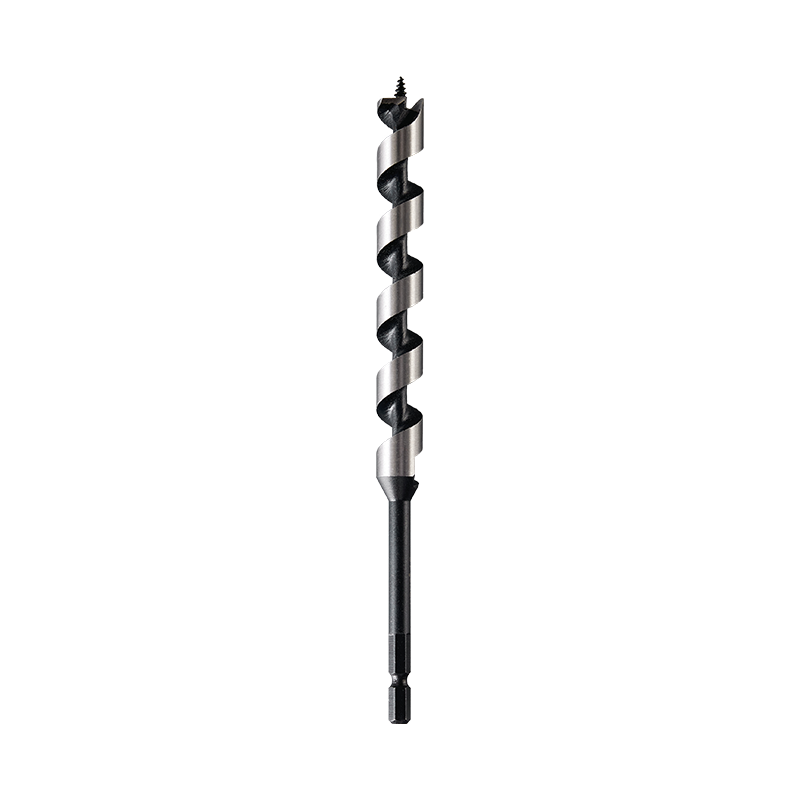
Auger bits have a deep helical flute and a screw-thread lead point that pulls the bit through the material. They excel at deep holes in thick timber — up to 450 mm (18 in.) — clearing chips continuously so the bit doesn't bind. Commonly used in timber framing, log building, and boat construction.
Forstner bits cut a flat-bottomed, cylindrical hole with exceptional wall quality. Unlike other wood bits, they can drill overlapping holes, angled holes, and holes at the edge of a board without drifting. Essential for hinge mortises, pocket holes, and decorative bores. They run slower and demand a drill press for best results in sizes above 25 mm.
A cylindrical saw blade fitted to an arbor, used for large-diameter through-holes — from 25 mm (1 in.) to 150 mm (6 in.) or larger. Common for door hardware, electrical boxes, and pipe penetrations. The center pilot drill keeps the cut registered; the saw ring cuts the perimeter and the slug drops free.
Combination bits drill a pilot hole, clearance hole, and countersink in one pass — purpose-built for wood screw installation. A drill bit for wood screws in this format ensures the screw seats flush or slightly below the surface without splitting the wood, especially near edges. Available in fixed and adjustable versions to match standard screw sizes (#6 through #14).
| Bit Type | Typical Size Range | Hole Quality | Best Use |
|---|---|---|---|
| Brad-Point | 3–25 mm | High | Joinery, cabinetry, dowels |
| Spade | 6–38 mm | Low–Medium | Rough framing, cable runs |
| Auger | 6–50 mm | Medium | Deep holes, thick timber |
| Forstner | 10–80 mm | Very High | Hinges, flat-bottom bores |
| Hole Saw | 25–150+ mm | Medium | Door hardware, pipe runs |
| Combination (Screw) | #4–#14 screw | High | Countersunk wood screws |
Identifying a bit correctly before drilling saves material and preserves your tooling. Here are the reliable visual and physical indicators:
When in doubt, check the packaging or manufacturer marking on the shank. Most quality bits stamp the material designation, size, and steel grade on the shank. "HSS" (High Speed Steel) alone indicates a general-purpose or metal-oriented bit; "HSS-W" or any brad/spur marking confirms it's optimized for wood.
Wood is an anisotropic, fibrous material — its resistance changes depending on whether you drill with or against the grain, and it varies dramatically between species. Balsa resists at roughly 400 N/mm² in compression; dense hardwoods like lignum vitae exceed 100 MPa in hardness. Metal drill bits can physically make a hole in wood, but the 118° point angle creates more heat through friction than necessary, and the tighter flutes can't clear chips fast enough at normal wood-drilling speeds, leading to burning or binding.
Metal, by contrast, is isotropic and work-hardens under excessive heat or pressure. Drilling steel requires the bit to maintain its hardness above the workpiece — HSS bits rated at 62–65 HRC are standard for mild steel, while stainless and tool steel demand cobalt-alloyed bits (M35 or M42 grade). Wood bits lack this hardness reserve and would dull almost immediately against ferrous material, often shattering the spur tips entirely on contact with steel.
Speed settings reinforce this difference. Wood drilling runs fast — 1,500 to 3,000 RPM for small brad-point bits in softwood, with speed decreasing as diameter increases. Metal drilling runs much slower: a 6 mm HSS bit in mild steel should run around 1,200–1,500 RPM; a 12 mm bit drops to 600–800 RPM. Applying metal-speed settings to a wood bit causes burning; applying wood-speed settings to a metal bit causes work-hardening and premature dulling.
Standard HSS twist bits occupy a middle ground and will work in both wood and soft metal with acceptable — not optimal — results. On a job site where one bit needs to drill through a wood stud and then a metal bracket, a general-purpose HSS twist bit is a practical choice. It won't perform as cleanly in wood as a brad-point bit, and it won't last as long in steel as a cobalt bit, but it handles both.
Bi-metal hole saws are another cross-material option. The high-speed steel teeth bonded to a spring-steel body allow them to cut through wood, thin sheet metal, and even plastic in a single pass — useful for electrical panel knockouts or multi-layer construction assemblies.
For the best drill bit for wood specifically — one that handles softwood, hardwood, plywood, and MDF with consistently clean results — a brad-point bit set in HSS or solid carbide remains the professional standard. Carbide brad-point bits cost significantly more but outlast steel variants by a wide margin in dense hardwoods and abrasive composites like MDF, which dulls steel rapidly due to the resin content in the binder.
In short: use dedicated wood bits for wood work where quality matters, dedicated metal bits for any ferrous or non-ferrous metal, and general HSS twist bits when cross-material convenience outweighs performance.
Matching the bit to the specific task — not just the material — produces better results and fewer wasted cuts.
I. Introduction: Solving the "Impossible" Task The phrase "fitting a square peg into a round hole" is a universal symbol...
READ MOREMetalworking has always been a cornerstone of industrial development, shaping everything from automotive components to a...
READ MORE1. What Are Waterpump Pliers? – The Flexible “All-Rounder” Tool In modern industrial manufacturing and daily maintenance...
READ MORESelecting the appropriate industrial cutting tools is a critical decision that directly impacts manufacturing efficiency...
READ MORE
+86-573-84611229

+86-573-84611518


NO.35 Yucao Road, Ganyao Town, Jiashan City, Zhejiang Province, China
