

 中文简体
中文简体 English
 русский
 Inquiry
Don't hesitate to send a message
I. Introduction: Solving the "Impossible" Task The phrase "fitting a square peg into a round hole" is a universal symbol...
READ MOREWood bits, masonry drills, and metal drill bits are not interchangeable — using the wrong bit for the material damages both the bit and the workpiece, produces poor-quality holes, and creates safety risks. The core rule is straightforward: use brad-point or spade bits for wood, carbide-tipped bits for masonry and concrete, and high-speed steel (HSS) or cobalt bits for metal. Each category has distinct geometry, tip design, and material hardness matched to how that substrate cuts, fractures, or abrades. This guide covers every major bit type within each category, with specific recommendations for drill speed, bit selection by application, and how to extend bit life.
Content
Wood is a relatively soft, fibrous material that cuts rather than abrades. Wood drill bits are designed with sharp cutting edges that sever wood fibers cleanly, a geometry that centers the bit accurately, and flute designs that evacuate chips efficiently to prevent binding and burning. The variety of wood bit types reflects the range of hole sizes, depth requirements, and finish quality demands encountered in woodworking.
Standard HSS twist bits work in wood but are not optimized for it. Their conical point tends to wander on smooth wood surfaces and the cutting geometry produces a rougher hole edge than dedicated wood bits. For quick utility holes where appearance is not critical — pilot holes for screws, rough framing work — a standard twist bit is adequate. For anything requiring a clean, accurate hole, a dedicated wood bit is worth the marginal additional cost.
Brad-point bits have a sharp center spur that registers precisely in the wood surface before the outer cutting spurs engage, preventing wander at the start of the hole. The two outer spurs score the hole perimeter before the main cutting lips remove material from inside the scored circle, producing a clean, tear-free hole edge on both face grain and cross-grain surfaces. Brad-point bits are the standard choice for cabinetry, furniture making, and any application where hole location precision and edge quality matter. Available in diameters from 3 mm to 25 mm (1/8 to 1 inch), they are the most versatile wood-specific bit for a standard drill or drill press.
Spade (paddle) bits use a flat blade with a center point and two cutting corners. They drill quickly and cheaply in the 16–50 mm (5/8 to 2 inch) range where brad-point bits become expensive and Forstner bits are slower. Hole quality is acceptable for rough carpentry — drilling holes for cable routing, pipe penetrations, and rough-in work — but edge quality is significantly rougher than brad-point or Forstner bits, and tearout on the exit face can be significant without a backing board. Spade bits require higher feed pressure than other wood bits and overheat quickly if not used at appropriate speed.
Forstner bits produce flat-bottomed, clean-edged holes with minimal tearout — essential for hinge mortises, dowel sockets, and decorative woodworking. The rim-cutting design allows the bit to drill partial holes at a board edge, overlapping holes, and holes at angles without wandering. Forstner bits require a drill press for best results — the high torque generated by the large rim diameter makes them difficult to control in a handheld drill, and they must be run at slow speeds: 250–500 RPM for sizes above 25 mm. Available from 10 mm to 100 mm diameter.
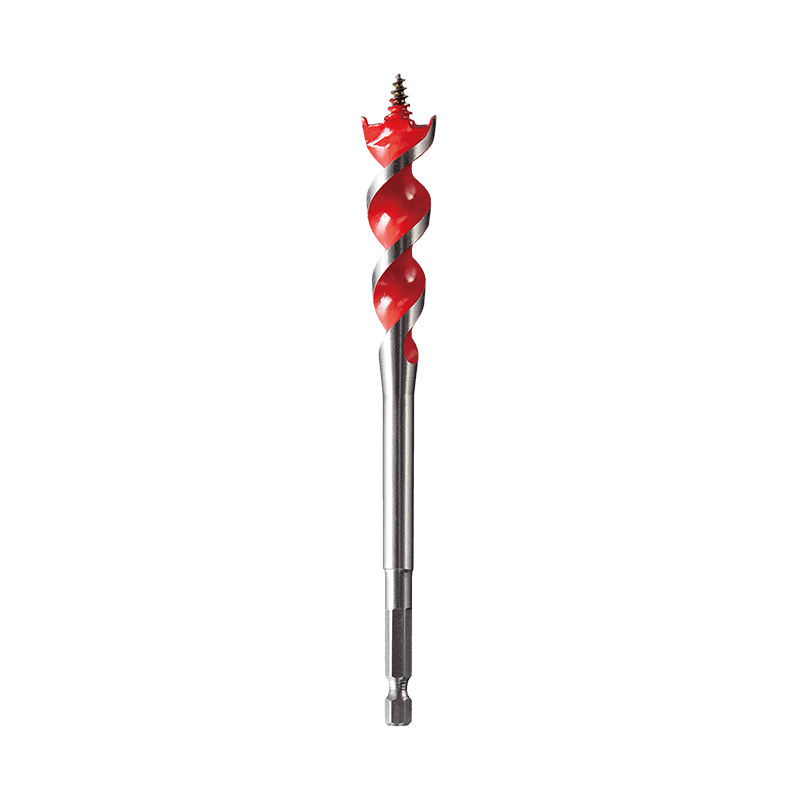
Auger bits have a screw-tip center point that pulls the bit into the wood under its own thread action, a single deep spiral flute that aggressively evacuates chips, and cutting spurs for clean perimeter scoring. They excel at drilling deep holes — through beams, thick timber, and stacked lumber — where standard bits would clog with chips and bind. Electrician's bell-hanger auger bits extend this principle to 450–900 mm lengths for routing wire through wall cavities and floor joists.
Hole saws use a cylindrical saw-tooth cup to cut large-diameter circles, leaving the central core intact. They cover diameters from 25 mm to 200 mm — the range above what Forstner bits practically cover — and are the correct tool for door locksets, plumbing penetrations, and recessed light cutouts. Bi-metal hole saws cut wood, thin wood composites, and drywall; carbide-grit hole saws cut harder materials. Use slow speeds (300–600 RPM for sizes above 50 mm) and withdraw periodically to clear chips.
| Bit Type | Size Range | Hole Quality | Best For | Drill Speed |
|---|---|---|---|---|
| Brad-point | 3–25 mm | Excellent | Cabinetry, furniture, dowels | 1,000–3,000 RPM |
| Spade / paddle | 16–50 mm | Fair | Rough carpentry, cable routing | 600–1,500 RPM |
| Forstner | 10–100 mm | Excellent | Hinge mortises, flat-bottom holes | 250–1,000 RPM |
| Auger | 6–38 mm | Good | Deep holes, thick timber | 500–1,500 RPM |
| Hole saw | 25–200 mm | Good | Large openings, locksets | 200–600 RPM |
Wood bits require higher speeds than masonry or metal bits of equivalent diameter. As a general rule, smaller diameter bits run faster and larger bits run slower to keep the peripheral cutting speed (the speed at the outer cutting edge) within the optimal range. Burning at the hole edge — indicated by black scorch marks and a burning smell — means the bit is running too fast, too slow with excessive feed pressure, or has dull cutting edges. Sharp bits at the correct speed produce clean chips, not dust, and cut without significant heat.
Masonry materials — concrete, brick, block, stone, and tile — are hard and brittle. They cannot be cut by a rotating edge alone; they must be fractured and pulverized by the impact of a hard tip, then cleared from the hole by the rotating flutes. Standard rotary drilling without hammer action is ineffective in dense concrete — it glazes the hole surface and destroys the bit without making meaningful progress. The correct tool is a hammer drill (rotary hammer action) with a carbide-tipped masonry bit for most concrete and masonry applications; a rotary-only drill with a masonry bit works adequately in softer brick and lightweight block.
Standard masonry bits have a tungsten carbide insert brazed to the tip of a steel body. The carbide insert — typically sintered WC-Co with 85–92% WC content — is ground to a chisel-point geometry that fractures masonry under impact loading. The steel body's spiral flutes carry the powdered debris out of the hole. These bits fit in standard 3-jaw drill chucks and are used in both standard drills and hammer drills. For light-duty use in brick and block, they perform well; for reinforced concrete or repeated deep holes, SDS-Plus or SDS-Max bits in dedicated rotary hammers are significantly more productive and durable.
SDS (Slotted Drive System) bits have a specialized shank with locking grooves that allow the bit to slide axially within the chuck while being rotationally driven — enabling the rotary hammer's piston mechanism to deliver hammer blows directly to the bit without those blows being transmitted to the operator's wrist through the chuck. SDS-Plus is the standard for bits up to approximately 26 mm diameter; SDS-Max handles bits from 16 mm to 80+ mm for heavy foundation drilling and large anchor installations. The energy delivered per blow in an SDS-Max rotary hammer is typically 8–25 joules, compared to 1–5 joules for SDS-Plus — the difference between drilling a 10 mm anchor hole in 5 seconds versus drilling a 40 mm core hole through a 300 mm wall in under a minute.
For holes above 50 mm in concrete and masonry — pipe penetrations, HVAC sleeves, electrical conduit entries — diamond core drill bits mounted in a core drill machine are the professional standard. Diamond core bits use a steel tube with diamond-impregnated segments on the cutting rim; they cut by grinding rather than impact and require water cooling to prevent diamond bond degradation. A 100 mm diamond core bit drilling through 200 mm of reinforced concrete typically takes 3–8 minutes and produces a smooth, cylindrical hole with no spalling at the entry or exit face — a quality level impossible to achieve with hammer drilling.
Ceramic and porcelain tile requires a different approach from concrete masonry. Never use hammer action on tile — the impact shatters the glaze and cracks the tile body. Use a carbide-tipped spear-point tile bit in rotary-only mode at moderate speed (400–800 RPM) with light, steady feed pressure. For porcelain tiles with hardness above 7 Mohs, diamond-grit hole saws or diamond-core bits in rotary mode with water cooling are the correct tools — carbide tips dull rapidly in hard porcelain and produce chipped hole edges. Starting the hole with a center punch or a piece of tape on the tile surface prevents the bit from skating across the glazed surface.
Metal drilling generates heat through cutting friction — managing that heat is the central challenge of metal drill bit selection and technique. Metal bits must be harder than the material being drilled, maintain a sharp cutting edge at elevated temperature, and have flute geometry that efficiently removes metal chips before they re-cut and generate additional heat. The wrong bit material, wrong speed, or wrong feed pressure in metal drilling results in work hardening of the hole surface, bit tip breakage, or catastrophic bit failure.
HSS (High-Speed Steel, typically M2 grade containing tungsten, molybdenum, chromium, and vanadium) is the baseline material for metal drill bits. HSS bits maintain hardness up to approximately 600°C (1,100°F) — sufficient for drilling mild steel, aluminum, copper, brass, and most non-ferrous metals at moderate speeds with cutting fluid. Standard HSS bits are available in the widest range of sizes at the lowest cost and are appropriate for general workshop and maintenance use where material being drilled is not hard or abrasive.
Cobalt HSS bits (M35 with 5% Co, or M42 with 8% Co) maintain hardness at temperatures up to 700–735°C and are significantly more wear-resistant than standard HSS in abrasive materials. For drilling stainless steel, hardened steel, cast iron, titanium, and high-nickel alloys, cobalt bits are the correct specification. M42 cobalt bits drilling 304 stainless steel last 3–5 times longer than standard HSS bits under identical conditions, justifying their 2–3× price premium for production use. Cobalt is alloyed throughout the steel matrix, not just a surface coating — cobalt bits can be resharpened multiple times without losing performance, unlike coated bits where resharpening removes the coating.
Solid carbide drill bits offer the highest hardness and wear resistance of any drill bit material — tungsten carbide at Rockwell A hardness of 90–93 HRA versus HSS at approximately 83–86 HRA. Solid carbide bits are used in CNC machining centers drilling hardened steel, cast iron, and composite materials where HSS and cobalt bits dull too quickly for economical production. They require rigid, vibration-free setups — carbide is brittle and shatters if side-loaded or subjected to drill walk — making them impractical for handheld drilling. Carbide-tipped (brazed) bits offer a compromise: carbide cutting edges with a tougher steel body, used in specialized metal drilling and tile drilling applications.
Metal drilling requires significantly lower RPM than wood drilling. The correct speed is calculated from the recommended surface cutting speed for the material-bit combination, divided back to RPM by the bit diameter. As a practical reference: a 6 mm HSS bit drilling mild steel should run at approximately 800–1,200 RPM; the same bit in stainless steel should run at 300–500 RPM with consistent feed pressure to avoid work hardening. Drilling stainless too slowly with insufficient feed pressure is as damaging as drilling too fast — the bit rubs without cutting, work-hardens the surface, and dulls immediately.
| Material | Recommended Bit | Approx. Speed (6mm) | Cutting Fluid |
|---|---|---|---|
| Mild steel | HSS or HSS-TiN | 800–1,200 RPM | Cutting oil recommended |
| Stainless steel (304/316) | HSS-Co (M35/M42) | 300–500 RPM | Essential (sulfurized oil) |
| Aluminum | HSS (sharp, polished flutes) | 2,000–4,000 RPM | WD-40 or light oil |
| Cast iron | HSS-Co or carbide | 500–800 RPM | Dry (iron chips self-lubricating) |
| Copper / brass | HSS (reduce lip angle) | 1,500–3,000 RPM | Light oil or dry |
| Hardened steel (>45 HRC) | Solid carbide or TiAlN coated | 200–400 RPM | Essential |
In practice, many drilling tasks involve composite situations — drilling through wood into concrete, through metal into masonry, or through multiple materials in sequence. Understanding the compatibility limits of each bit type prevents damage and wasted effort.
Drill bits are consumables, but their service life varies enormously based on how they are used, stored, and maintained. A quality cobalt bit used correctly can drill hundreds of holes in steel; the same bit used at wrong speed without cutting fluid may fail after ten holes.
I. Introduction: Solving the "Impossible" Task The phrase "fitting a square peg into a round hole" is a universal symbol...
READ MOREMetalworking has always been a cornerstone of industrial development, shaping everything from automotive components to a...
READ MORE1. What Are Waterpump Pliers? – The Flexible “All-Rounder” Tool In modern industrial manufacturing and daily maintenance...
READ MORESelecting the appropriate industrial cutting tools is a critical decision that directly impacts manufacturing efficiency...
READ MORE
+86-573-84611229

+86-573-84611518


NO.35 Yucao Road, Ganyao Town, Jiashan City, Zhejiang Province, China
