

 中文简体
中文简体 English
 русский
 Inquiry
Don't hesitate to send a message
I. Introduction: Solving the "Impossible" Task The phrase "fitting a square peg into a round hole" is a universal symbol...
READ MOREContent
A drill bit is a cutting tool designed to remove material from a workpiece by rotating under axial pressure, producing a cylindrical hole of defined diameter. The bit is held and driven by a drill — hand-powered, electric, pneumatic, or hydraulic — and cuts through the target material via one or more sharpened cutting edges at its tip. Chips or swarf generated by the cutting action are evacuated from the hole through helical flutes machined along the bit's body, preventing re-cutting of removed material and allowing the bit to advance without clogging.
Drill bits are among the most fundamental cutting tools in manufacturing, construction, and maintenance. Every industry that works with solid materials — metal fabrication, woodworking, construction, mining, oil and gas, electronics manufacturing, medicine — uses drill bits as a primary method of hole generation. A typical modern machine shop may stock several hundred distinct bit types, sizes, and coatings; a residential toolbox contains at minimum a general-purpose set covering the most common sizes for wood and light metal.
The defining specifications of any drill bit are its diameter (which determines the hole size), its material and hardness (which determines what it can cut), its point geometry (which determines how it enters the material and controls walking), and its flute design (which governs chip evacuation and cutting speed). Changing any one of these parameters produces a fundamentally different tool with a different optimal application.
The history of the drill bit spans at least 35,000 years, making hole-making one of the oldest deliberate material-working activities in human history. Archaeological evidence from the Upper Paleolithic shows flint points used to bore holes in shells and bone — the earliest examples of rotary cutting by a held tool. These were not drill bits in the mechanical sense, but they represent the first intentional application of rotational abrasion to penetrate solid material.
The bow drill — a pointed hardwood or flint rod rotated by wrapping a bow's string around it and drawing the bow back and forth — appears in Egyptian wall paintings from around 3000 BCE and was used for both woodworking and fire-making. The pump drill, which used a weighted flywheel and a pump handle to maintain continuous rotation, followed in early Mesoamerican and Asian cultures. Roman craftsmen used iron-tipped spoon bits and center bits for woodworking, forms recognizable in modern auger and center bit designs. Throughout the medieval period, brace-and-bit sets — using a cranked wooden or iron brace to drive spoon bits and augers — were the primary hole-making tools for carpentry, cooperage, and shipbuilding.
The modern twist drill bit — the helically fluted design that remains the dominant drill bit form today — was invented by American engineer Steven Morse in 1861 and patented in 1863. Morse's insight was to machine continuous helical flutes along the length of a steel rod, creating both the cutting edges at the tip and an automatic chip evacuation channel in a single integrated geometry. Before the twist drill, hole-making in metal required laborious filing, punching, or the use of flat "spade" bits that clogged rapidly and required frequent withdrawal to clear chips. Morse's design, initially produced by twisting heated flat bar stock into a helix, could drill continuously without withdrawal and produced cleaner, more accurately sized holes at far higher speed. The Morse taper shank — the self-holding tapered interface between larger drill bits and machine spindles — is also Morse's invention and remains the international standard for drill press and lathe chuck interfaces to this day.
The industrialization of metalworking in the late 19th and early 20th centuries drove rapid material advances. Carbon steel bits, standard through the 1890s, softened at the elevated temperatures generated by high-speed machining — limiting cutting speeds and tool life. High-speed steel (HSS), developed around 1900 by Frederick Taylor and Maunsel White at Bethlehem Steel, retained its hardness at temperatures up to 600°C, enabling cutting speeds 2–4× faster than carbon steel without dulling. HSS became the universal drill bit material through most of the 20th century and remains dominant for general-purpose bits today.
Cemented carbide — tungsten carbide particles sintered in a cobalt binder — was developed in Germany in the 1920s and gradually entered drill bit applications through the mid-century. Carbide's hardness (approximately 9.5 on the Mohs scale, compared to HSS at around 7.5) and heat resistance (retaining cutting ability above 900°C) made it essential for drilling hardened steel, cast iron, abrasive composites, and ceramic materials that destroy HSS bits in seconds. Physical vapor deposition (PVD) coating technology in the 1970s and 1980s introduced titanium nitride (TiN), titanium aluminum nitride (TiAlN), and other hard coatings that further extended bit life by reducing friction and oxidation at the cutting edge — setting the stage for the high-performance coated carbide bits standard in CNC machining centers today.
Drill bits are used wherever a cylindrical hole must be created in a solid material — which encompasses an almost unlimited range of industries and applications. The specific use determines the required bit type, material, geometry, and size. Using the correct bit for a given material is not merely a matter of efficiency; mismatched bits damage workpieces, wear out prematurely, overheat, and in hard materials can shatter dangerously.
Drilling is one of the most common operations in metal fabrication — producing clearance holes for fasteners, tapping holes for threads, access holes for wiring, and precision bores for bearings and shafts. HSS twist drills cover the majority of steel, aluminum, brass, and copper drilling. Cobalt HSS (M35 or M42 grade, containing 5–8% cobalt) is used for stainless steel, Inconel, and other work-hardening alloys where standard HSS dulls rapidly. Solid carbide drills dominate CNC machining of hardened steel, titanium, and carbon fiber composite, where cutting speeds of 80–200 m/min and hole tolerances of ±0.01 mm are routinely achieved.
Drilling into concrete, brick, stone, and block requires percussive action combined with rotation — the bit must both cut and fracture the brittle crystalline structure of the material. Masonry drill bits use a carbide tip brazed or pressed into a steel body, and are driven by hammer drills or rotary hammers that deliver impact blows at 1,000–4,500 beats per minute alongside rotation. SDS-Plus and SDS-Max shank systems, developed by Bosch in 1975, allow the bit to slide axially within the chuck during hammering — transmitting impact energy to the workface more efficiently than a conventional chuck while preventing bit loss. For larger diameter holes in concrete (core drilling for conduit, plumbing, or HVAC), diamond core bits — steel tubes with industrial diamond segments bonded to the cutting face — are the only practical solution, often used with water cooling to prevent segment damage.
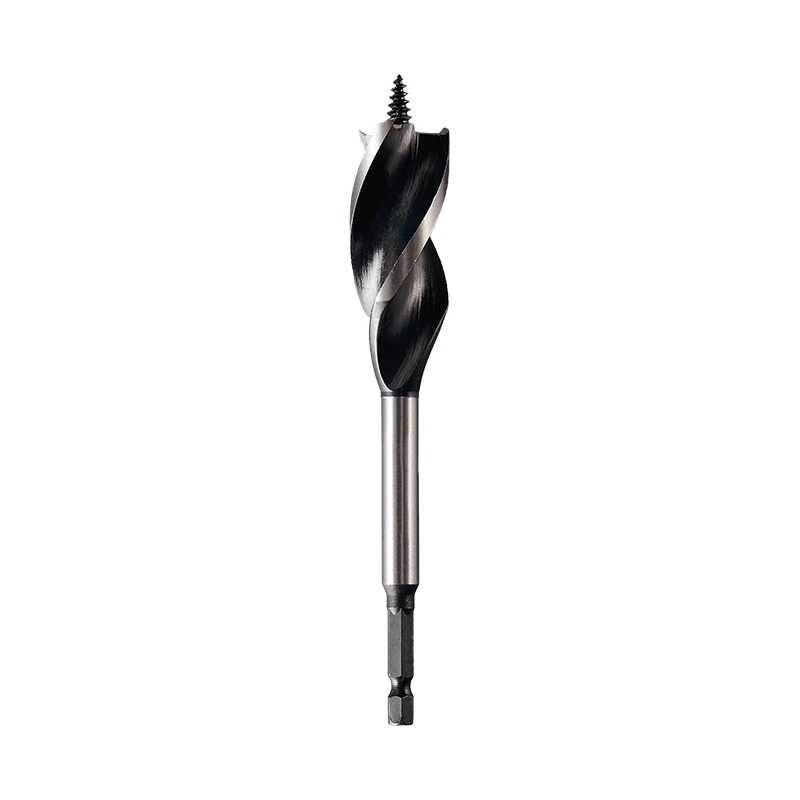
Wood drilling encompasses the widest variety of specialized bit types of any material category, because wood's grain structure, density variation, and end-grain behavior demand different cutting geometries for different applications. Brad-point bits use a center point to prevent walking on wood surfaces and two spurs to score the grain before the main cutting edges remove the core — producing clean, tear-out-free holes for dowels, shelf pins, and cabinetry. Forstner bits use a full-diameter rim cutter and radial chiseling edges to bore flat-bottomed, overlapping, or angled holes that twist drills cannot produce — essential for concealed hinge installation and furniture joinery. Spade bits are inexpensive and fast for rough framing holes (pipe and wire passes) where surface quality is not critical. Auger bits, with their aggressive helical screw tip and coarse flute, are used in timber framing and log construction for deep holes in green or dense hardwood.
Printed circuit board drilling uses solid carbide micro-drills — often as small as 0.1 mm diameter — running at spindle speeds of 100,000–300,000 RPM on CNC drilling machines to produce through-holes for component leads and plated vias. PCB laminates (FR-4 fiberglass, PTFE, ceramic-filled composites) are highly abrasive and would destroy HSS bits in a few holes; only carbide survives the abrasion at production volumes. Tool life is measured in hit counts — a 0.3 mm carbide drill in standard FR-4 is typically retired after 3,000–5,000 holes to maintain hole wall quality for reliable plating adhesion.
At the largest scale, drill bits for oil and gas wellbores are engineering systems in their own right. Tricone roller cone bits use three interlocking toothed cones — steel-tooth or tungsten carbide insert — that crush and fracture rock as the assembly rotates on the bottom of the drill string. Polycrystalline diamond compact (PDC) bits use synthetic diamond cutters bonded to a steel or carbide body in a fixed configuration, shearing rock rather than crushing it — achieving 3–10× longer bit life and higher penetration rates in the medium-hardness formations that dominate most oil and gas reservoirs. A single PDC bit can cost $50,000–$100,000 and must drill hundreds of meters of hard rock at depths exceeding 5,000 meters under extreme heat, pressure, and abrasion.
Drill bit variety reflects the diversity of materials, hole geometries, and operating conditions encountered across industries. The following covers the most widely used types with their distinguishing characteristics and correct application contexts.
| Bit Type | Tip Geometry | Best Material | Key Feature |
|---|---|---|---|
| Twist Drill (HSS) | 118° or 135° split point | Steel, aluminum, wood | General purpose, widely available |
| Cobalt HSS Twist | 135° split point | Stainless, Inconel, hardened steel | Heat-resistant, no center punch needed |
| Solid Carbide | Variable (application-specific) | Hardened steel, Ti, CFRP, ceramics | Maximum hardness and speed in CNC |
| Brad-Point | Center pin + two spurs | Wood, MDF, plywood | Clean entry, no grain tear-out |
| Forstner | Rim cutter + center point | Wood, soft plastics | Flat-bottom holes, overlapping bores |
| Masonry (Carbide Tip) | Carbide brazed tip | Concrete, brick, stone | Requires hammer action |
| Step Drill | Stepped cone profile | Thin sheet metal, plastics | Multiple sizes, one-step deburring |
| Diamond Core | Segmented diamond rim | Concrete, tile, glass, stone | Large diameter, wet-cut cooling |
Coatings on HSS and carbide bits are not decorative — each addresses a specific failure mode. Titanium nitride (TiN, gold color) reduces friction at the cutting edge and increases surface hardness, extending bit life by 3–5× versus uncoated HSS in mild steel. Titanium aluminum nitride (TiAlN, dark violet) forms an aluminum oxide layer at high temperatures that acts as a thermal barrier — the coating performs better the hotter it gets, making it ideal for dry machining of hardened steel and stainless at high speeds. Black oxide is a mild surface treatment that reduces friction marginally and improves corrosion resistance — it extends bit life modestly and is common on economy general-purpose sets. Diamond-like carbon (DLC) coatings provide very low friction and are used for drilling non-ferrous metals and CFRP composites where built-up edge (material welding to the cutting edge) is the primary failure mode.
Standard jobber-length twist drills — the default length in most drill sets — have flute lengths approximately 9–14× the bit diameter and are designed for the majority of through-hole and shallow blind-hole applications. Longer drill bits become necessary when hole depth exceeds what a jobber bit can reach, when the workpiece geometry prevents positioning the drill directly over the entry point, or when multiple components must be drilled in alignment through an assembled stack.
Drill bit length is categorized by industry-standard series. Jobber-length bits are the most common — appropriate for holes up to approximately 10× diameter in most materials. Taper-length bits are 20–30% longer than jobber, covering deeper holes without the deflection risk of longer series. Aircraft extension bits (also called extra-long or extended-length bits) reach 6, 12, or 18 inches in total length — used in aerospace assembly to drill through wing skins and structural members from a distance, in plumbing and electrical rough-in to pass through multiple studs or joists in a single pass, and in furniture assembly jigs where drill access is restricted by the workpiece. Deep-hole gun drills are a specialized category entirely: single-flute tools with internal coolant channels used in CNC gundrilling machines to produce holes 50–300× diameter in depth — hydraulic valve bodies, injection molding cooling channels, and rifle barrels are all gundrilled.
Extended length introduces mechanical challenges that do not exist at jobber length. Deflection — the tendency of a long, thin tool to bend under cutting forces — causes hole straightness errors that compound with depth. A 12-inch, 1/4-inch diameter bit has a length-to-diameter ratio of 48:1, at which point even modest lateral forces produce measurable hole deviation. Managing this requires reduced feed rates (the axial advance per revolution), reduced cutting speed, more frequent peck cycles (retracting the bit partially to break and evacuate chips), and in precision applications, the use of a drill bushing at the entry point to constrain the bit during the critical first few diameters of engagement. Chip evacuation becomes the dominant concern at depths beyond 5× diameter — chips that cannot exit the flutes pack against the cutting edge, generating heat, increasing torque, and causing bit breakage. Applying cutting fluid at the entry point and using peck drilling routines (repeated partial-depth advances and retractions) addresses this in manual and CNC drilling alike.
The correct approach is to use the shortest bit that physically accomplishes the task. A longer bit than necessary adds deflection risk and reduces rigidity without any compensating benefit. For a 3-inch-deep hole in steel, a taper-length bit is appropriate; an aircraft extension bit would introduce unnecessary flex. For drilling through a 14-inch timber, a long aircraft bit or a ship auger is required by geometry. In production environments, custom-length bits ground to the exact application depth are common — eliminating excess length and maximizing rigidity at the point of cut. For construction rough-in where a standard long bit must drill through multiple framing members, flexible shaft extensions (with a standard bit chuck at the end) allow the drill motor to be positioned away from the work axis entirely — useful in extremely confined spaces where even an aircraft-length bit cannot be aligned with the required hole path.
I. Introduction: Solving the "Impossible" Task The phrase "fitting a square peg into a round hole" is a universal symbol...
READ MOREMetalworking has always been a cornerstone of industrial development, shaping everything from automotive components to a...
READ MORE1. What Are Waterpump Pliers? – The Flexible “All-Rounder” Tool In modern industrial manufacturing and daily maintenance...
READ MORESelecting the appropriate industrial cutting tools is a critical decision that directly impacts manufacturing efficiency...
READ MORE
+86-573-84611229

+86-573-84611518


NO.35 Yucao Road, Ganyao Town, Jiashan City, Zhejiang Province, China
