

 中文简体
中文简体 English
 русский
 Inquiry
Don't hesitate to send a message
I. Introduction: Solving the "Impossible" Task The phrase "fitting a square peg into a round hole" is a universal symbol...
READ MOREContent
Pliers look interchangeable at a glance, but each type is built for a specific gripping, cutting, or bending task — and using the wrong one usually means a worse result and a shorter tool life. This guide breaks down the most common types of pliers, how they compare, and how to choose the right ones for the job.
Hardware pliers types generally fall into a few core categories based on jaw shape and mechanism: gripping pliers, cutting pliers, locking pliers, and adjustable pliers. Understanding what each jaw shape and joint type is designed for makes it much easier to pick the right tool without guessing.
Flat gripping section plus a cutting edge, the most common general-purpose plier.
Narrow, tapered jaws for precision work in tight spaces.
Adjustable pivot point offering two jaw-opening positions.
Jaws clamp and lock in place, freeing up your hands.
| Factor | Combination Pliers | Long Nose Pliers |
|---|---|---|
| Jaw shape | Flat, wide gripping surface | Narrow, tapered, pointed tip |
| Best for | General gripping, twisting, and cutting | Precision work in tight or confined spaces |
| Cutting edge | Usually built in near the pivot | Sometimes included near the base of the jaws |
| Typical use case | Electrical work, general repairs, wire twisting | Jewelry making, electronics, small component handling |
Comparison of combination pliers and long nose pliers.
Combination pliers are the default choice for general-purpose gripping and light cutting, while long nose pliers earn their place whenever a job requires reaching into a tight space or handling small components with more precision than wide flat jaws can offer.
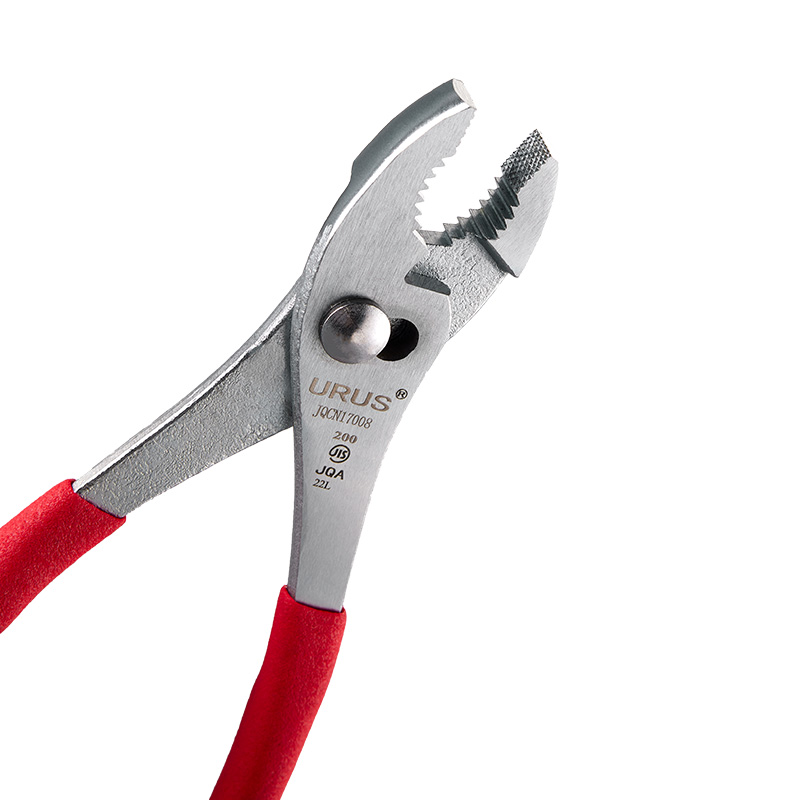
Slip joint pliers have a simple pivot with two fixed jaw-opening positions, giving limited but quick adjustability for everyday tasks. Groove joint pliers (often called channel-lock or tongue-and-groove pliers) use a series of grooves along an angled slot, allowing the jaws to be set to a much wider range of opening sizes for gripping larger or irregularly shaped objects like pipes and fittings.
In practice, slip joint pliers suit lighter, everyday household tasks, while groove joint pliers are the better choice for plumbing, larger nuts, and any job where the jaw needs to open significantly wider than a standard plier allows.
Regular pliers rely on continuous hand pressure to maintain grip, meaning the jaws release as soon as you let go. Locking pliers (often known by the Vise-Grip name) use a cam and adjustment screw mechanism that lets the jaws clamp down and stay locked in place without continued hand pressure, essentially turning the tool into a temporary clamp.
This makes locking pliers especially useful for holding a workpiece steady while you use your hands for another task, such as welding, drilling, or turning a stubborn stripped bolt head — something regular pliers simply can't do on their own.
| Factor | Cutting Pliers | Combination Pliers |
|---|---|---|
| Primary function | Cutting wire, cable, or small metal stock | Gripping, twisting, and moderate cutting |
| Jaw design | Sharpened cutting edges, little to no gripping surface | Flat gripping surface with a smaller cutting section |
| Best for | Dedicated wire cutting, electrical, or cable work | General-purpose tasks needing both grip and occasional cutting |
Comparison of dedicated cutting pliers and general-purpose combination pliers.
Dedicated cutting pliers — including diagonal cutters and end cutters — deliver a cleaner, more controlled cut than the built-in cutting edge on a combination plier, which matters most for electrical or precision work where a clean cut affects the finished result.
| Application | Recommended Pliers |
|---|---|
| Electrical work | Long nose and diagonal cutting pliers for wiring and terminations |
| Plumbing | Groove joint pliers for gripping pipes and fittings |
| Automotive repair | Locking pliers for holding parts during repair work |
| General household | Combination and slip joint pliers for everyday tasks |
Common applications matched to the most suitable plier type.
Task type: gripping, cutting, clamping, or precision work each point to a different plier type.
Jaw opening range: larger or irregular objects call for groove joint pliers rather than fixed-position types.
Workspace access: tight or confined spaces favor long nose or angled-jaw pliers.
Hands-free needs: tasks requiring a steady clamp while both hands are busy call for locking pliers.
Material being worked: match cutting plier hardness rating to the wire or material gauge being cut.
Most toolkits benefit from a small core set — combination pliers, long nose pliers, groove joint pliers, and a pair of locking pliers — which together cover the majority of gripping, cutting, and clamping tasks without needing a highly specialized tool for every job.
I. Introduction: Solving the "Impossible" Task The phrase "fitting a square peg into a round hole" is a universal symbol...
READ MOREMetalworking has always been a cornerstone of industrial development, shaping everything from automotive components to a...
READ MORE1. What Are Waterpump Pliers? – The Flexible “All-Rounder” Tool In modern industrial manufacturing and daily maintenance...
READ MORESelecting the appropriate industrial cutting tools is a critical decision that directly impacts manufacturing efficiency...
READ MORE
+86-573-84611229

+86-573-84611518


NO.35 Yucao Road, Ganyao Town, Jiashan City, Zhejiang Province, China
