

 中文简体
中文简体 English
 русский
 Inquiry
Don't hesitate to send a message
I. Introduction: Solving the "Impossible" Task The phrase "fitting a square peg into a round hole" is a universal symbol...
READ MOREIn the world of craftsmanship, construction, and DIY, the quality and appropriateness of your tools directly dictate the quality of your work. Professional hand tools are the backbone of precise, efficient, and safe operations across industries. Unlike standard consumer-grade tools, they are engineered for durability, ergonomics, and performance under demanding conditions. This comprehensive guide delves into the essentials of professional-grade tools, offering insights into selection, specialized applications, and care to empower both seasoned professionals and serious enthusiasts.
Content
Professional-grade tools represent a significant investment, but the return in terms of performance, safety, and longevity is unparalleled. They are designed for continuous use, reducing user fatigue and increasing productivity. Manufacturers like Zhejiang URUS Tools Co., Ltd., with nearly three decades of expertise and ISO9001:2015 certified manufacturing processes, understand that a tool is an extension of the worker's hand. The difference lies in the details: superior materials like chrome vanadium steel, precise calibration, and rigorous testing ensure that each tool meets exacting standards for tasks ranging from delicate electronics repair to heavy-duty industrial assembly.
A well-equipped toolbox is curated for versatility. Here are the foundational categories every professional should consider.
This category includes pliers, wire cutters, and wrenches. For instance, understanding the best pliers for electrical work is critical for electricians. Such pliers feature insulated handles, precise cutting edges for clean wire shearing, and often a dedicated crimping area. A comparison between common types highlights their specialization:
While diagonal cutters are superb for flush-cutting wires, long-nose pliers excel at reaching into confined spaces and bending wire with precision. Lineman's pliers, on the other hand, are the workhorse for twisting and cutting heavier gauge wire.
| Tool Type | Primary Function | Key Feature for Professionals |
|---|---|---|
| Long-Nose Pliers | Gripping, bending, positioning in tight spaces | Fine, tapered jaws for detailed work |
| Lineman's Pliers | Cutting, twisting, gripping heavy wire | High-leverage design and robust cutting notch |
| Diagonal Cutters | Flush-cutting wires and pins | Angled blades for access in crowded electrical boxes |
Hammers, mallets, screwdrivers, and ratchets fall into this group. The choice of a hammer, for example, depends entirely on the material being struck. A dead blow hammer prevents rebound and marring surfaces, while a ball-peen hammer is intended for metalworking.
Accuracy begins with measurement. Precision squares, calipers, and levels ensure that work meets specifications. A high-quality combination square, for example, is indispensable for marking perfect 90 and 45-degree angles.
Specialized tasks demand specialized tools. Here, we explore five common professional scenarios and the optimal tool choices, addressing specific long-tail queries professionals often have.
Woodworking requires tools that make clean, accurate cuts and joints. For tasks like dovetail joinery, a high-quality dovetail saw for fine woodworking is non-negotiable. Its thin blade and fine teeth allow for controlled, straight cuts. Compared to a general-purpose backsaw, a dedicated dovetail saw offers greater control and a thinner kerf, resulting in tighter-fitting joints.
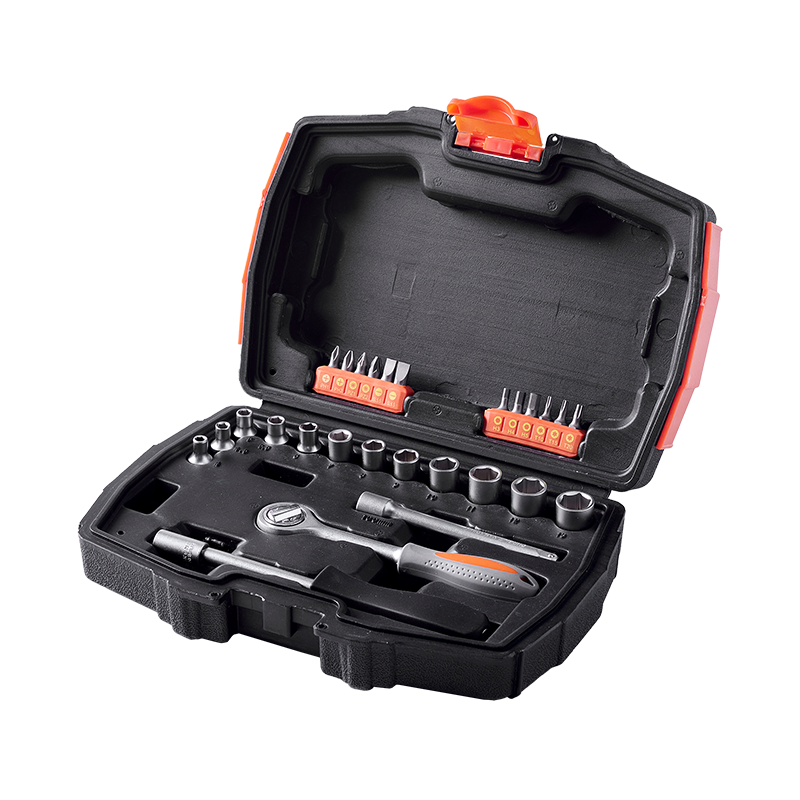
Automotive work involves high torque, rusted fasteners, and confined spaces. A professional ratchet and socket set for mechanics is the cornerstone of any automotive toolkit. The ratchet's tooth count is crucial; a higher tooth count (e.g., 72 or 90) allows for smaller swing arcs in tight engine bays.
While a standard 12-point socket fits onto fasteners more quickly, a 6-point socket offers greater contact area and is less likely to round off worn or stubborn bolts, making it the safer choice for high-torque applications.
| Socket Drive Size | Typical Use Case | Torque Capacity |
|---|---|---|
| 1/4 inch | Interior panels, small engine components | Low to Medium |
| 3/8 inch | General engine work, suspension components | Medium |
| 1/2 inch | Lug nuts, crankshaft bolts, high-torque applications | High |
Plumbers need tools that can handle pipe work, fittings, and stubborn connections. A pipe wrench for industrial plumbing is iconic for a reason. Its adjustable, serrated jaw bites into pipes to provide immense turning force. However, using the correct size is vital to avoid damaging the pipe.
HVAC technicians work with sheet metal, refrigeration lines, and electrical systems. A key task is creating secure, leak-free connections on refrigeration tubing, which requires a specialized flaring tool for HVAC tubing. This tool shapes the end of a copper tube into a flare that seals against a fitting when compressed.
A single-clutch flaring tool is simpler and more common, but a dual-clutch or precision flaring tool provides a more consistent, concentric flare with less risk of thinning or cracking the copper, which is critical for system integrity and preventing refrigerant leaks [1].
For facility managers or assembly line technicians, efficiency across diverse tasks is key. A comprehensive, well-organized heavy-duty hand tool kit for contractors saves time and ensures the right tool is always at hand. These kits are carefully curated to cover a broad range of fastening, cutting, and gripping needs without unnecessary duplication.
The performance of a tool is rooted in its material and how it's made. Leading manufacturers invest heavily in metallurgy and process control.
Companies operating at a high level, such as Zhejiang URUS Tools Co., Ltd., a national high-tech enterprise with its own municipal R&D center, focus on these precise engineering details to produce drill bits, pliers, and tool sets that meet international standards for export to markets in Japan, Europe, and North America.
A professional tool is a long-term asset. Proper care ensures it performs for a lifetime.
Selecting the right professional hand tools is a strategic decision that impacts efficiency, safety, and job quality. By understanding the specific demands of your trade—whether it's finding the best pliers for electrical work or a reliable pipe wrench for industrial plumbing—you invest in tools that work as hard as you do. Prioritizing quality manufacturing, proper selection for specialized tasks like using a dovetail saw for fine woodworking or a flaring tool for HVAC tubing, and committing to regular maintenance will build a toolkit that is not just a collection of instruments, but a foundation for professional excellence. For professionals seeking reliability, a comprehensive professional ratchet and socket set for mechanics or a heavy-duty hand tool kit for contractors from experienced manufacturers represents a wise and enduring investment in one's craft.
Professional hand tools are built for durability, precision, and continuous use. They utilize higher-grade materials (like chrome vanadium steel), undergo stricter manufacturing controls (e.g., forging, precise heat treatment), and feature ergonomic designs to reduce fatigue. Consumer tools are typically designed for lighter, occasional use and may compromise on material quality and precision to meet a lower price point.
Select a pipe wrench where the jaw capacity matches the pipe diameter. The wrench should grip the pipe firmly along several teeth of the jaw. A wrench that is too large may not grip properly and can crush the pipe, while one that is too small won't provide enough leverage. As a rule, the wrench length should be about 12-16 inches for common 1/2-inch to 1-inch diameter pipes.
A higher tooth count (e.g., 72, 90, or even 120 teeth) means the gear inside the ratchet head has finer increments. This allows you to turn the fastener in much tighter spaces because the handle only needs a small "swing arc" to engage the next tooth. This is invaluable in confined areas like engine compartments or inside cabinetry.
It is not recommended. A general-purpose saw has a thicker blade and coarser teeth designed for fast, rough cuts. A dedicated dovetail saw for fine woodworking has a thin blade (for a narrow kerf), fine teeth, and a rigid back for perfectly straight, controlled cuts. Using the wrong saw will result in ragged, imprecise joints that do not fit tightly.
Basic maintenance should be performed after every use: wipe off debris and moisture. A more thorough inspection and light lubrication should be done weekly or monthly, depending on frequency of use. Always store tools in a dry, organized place. Sharpening cutting tools should be done as soon as you notice a decline in performance.
[1] ASHRAE Handbook -- HVAC Systems and Equipment. American Society of Heating, Refrigerating and Air-Conditioning Engineers. This reference provides industry-standard practices and technical specifications for tubing and flaring procedures in HVAC systems, underscoring the importance of tool precision for system integrity.
I. Introduction: Solving the "Impossible" Task The phrase "fitting a square peg into a round hole" is a universal symbol...
READ MOREMetalworking has always been a cornerstone of industrial development, shaping everything from automotive components to a...
READ MORE1. What Are Waterpump Pliers? – The Flexible “All-Rounder” Tool In modern industrial manufacturing and daily maintenance...
READ MORESelecting the appropriate industrial cutting tools is a critical decision that directly impacts manufacturing efficiency...
READ MORE
+86-573-84611229

+86-573-84611518


NO.35 Yucao Road, Ganyao Town, Jiashan City, Zhejiang Province, China
