

 中文简体
中文简体 English
 русский
 Inquiry
Don't hesitate to send a message
I. Introduction: Solving the "Impossible" Task The phrase "fitting a square peg into a round hole" is a universal symbol...
READ MOREIn the world of hand tools, few are as versatile and essential as the long nose pliers. Also known as needle-nose pliers, these tools are a fundamental component of any toolkit, from professional electrical work to intricate DIY crafts. This comprehensive guide delves into the anatomy, functionality, and expert selection criteria for long nose pliers, providing you with the knowledge to choose and use the right tool for your project. We'll also explore specialized variations like long nose pliers for electronics and long reach needle nose pliers for tight spaces to meet specific challenges.
Content
Long nose pliers are characterized by their elongated, tapered jaws that come to a fine point. This design is not arbitrary; it serves a distinct purpose. The primary function is to grip, manipulate, bend, and cut materials in confined areas where fingers or bulkier tools cannot reach. Their precision makes them indispensable.
Not all long nose pliers are created equal. Different designs cater to specific tasks. Choosing the correct type is crucial for efficiency and safety.
The most common type, featuring smooth or slightly serrated jaws. Ideal for general bending and holding.
This versatile hybrid combines gripping jaws with a flush-cutting edge near the pivot, making it a true multi-tool.
Featuring jaws that are angled at 45 or 90 degrees, these pliers provide access to obstructed or recessed components.
These pliers have exceptionally long and sometimes slender jaws, designed to delve deep into cavities, engine bays, or ductwork.
Engineered for precision, these often have fine, smooth tips to prevent damage to delicate components and may include features like spring-loaded handles for reduced hand fatigue [1].
Selecting between similar plier types can be confusing. To make an informed decision, a direct comparison is helpful. For instance, when deciding between standard and electronics-grade pliers, or between straight and bent nose models, the key differences lie in their precision, reach, and primary application.
The table below contrasts standard long nose pliers with bent nose pliers to highlight their optimal use cases.
| Feature | Standard Long Nose Pliers | Bent Nose Pliers |
|---|---|---|
| Jaw Profile | Straight, tapered to a point | Jaws angled at 45° or 90° |
| Primary Advantage | Direct, in-line access and control | Access around corners and obstacles |
| Ideal Use Case | Working in open, visible areas (e.g., forming wire loops) | Working in recessed or confined areas (e.g., automotive engine compartments) |
| Precision Level | High | High, but leverage may differ due to angle |
Beyond common tasks, certain specialized pliers solve very specific problems. Understanding these can save significant time and frustration on specialized projects.
Jewelry making demands precision and care to avoid marring soft metals. Long nose pliers are perfect for opening and closing jump rings, forming delicate wire wraps, and positioning small beads.
Safety and functionality are paramount. The best long nose pliers for electrical work must be reliably insulated (often rated at 1000V), have a comfortable grip for prolonged use, and incorporate a robust side cutter for trimming wires.
For mechanics, technicians, and tradespeople, tool failure is not an option. Durable long nose pliers for professional use are defined by their construction. They are typically forged from high-grade chromium-vanadium steel, feature a precise, tight-fitting pivot to eliminate wobble, and undergo hardening and tempering processes for optimal strength and toughness [2].
Proper care extends tool life and ensures user safety. This is especially true for precision tools like long nose pliers.
The difference between a frustrating tool failure and a job well done often lies in manufacturing quality. As a professional manufacturer with nearly three decades of experience, Zhejiang URUS Tools Co., Ltd. understands this intimately. Founded in 1995 and operating from a 65,000 square meter facility in Zhejiang, URUS Tools embodies the principles of precision manufacturing.
Our attainment of ISO9001:2015 certification and recognition as a national high-tech enterprise underscore a commitment to systematic quality management and innovation. Every pair of pliers, from long nose pliers for electronics to durable long nose pliers for professional use, is engineered considering material science, ergonomics, and end-user application. By controlling the process from forging to finishing, we ensure that each tool delivers the precision, durability, and reliability that professionals and discerning DIYers depend on. Our optimal logistics connections facilitate the export of these quality tools to markets worldwide, including Japan, Europe, and the United States.
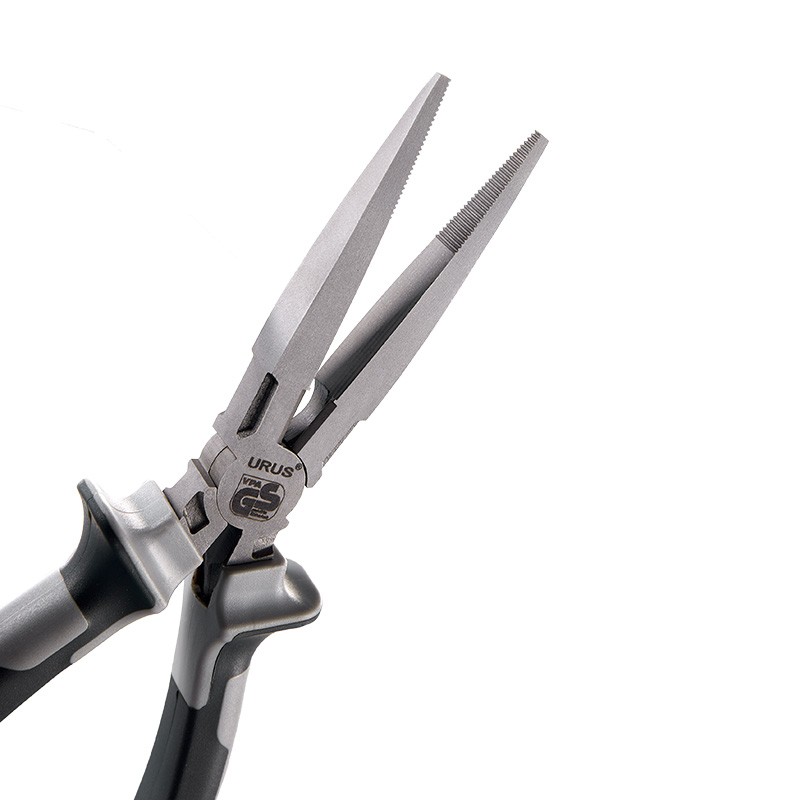
They are essentially the same tool. "Long nose" and "needle nose" are interchangeable terms describing pliers with long, tapered jaws. Some may argue "needle nose" implies a finer, more pointed tip, but the distinction is not standardized.
You can, but it is not safe for live circuits. Only use pliers with properly rated and undamaged insulated handles (e.g., VDE certified) for electrical work to prevent electric shock.
Most pliers have a riveted pivot. You can often tighten it by carefully peening (lightly hammering) the rivet head on a solid surface. For a bolted pivot, simply tighten the nut. If unsure, consult a professional.
Focus on jaw length and tip design. Ensure the jaws are long enough for your needs but also robust enough to resist flexing. A slight serration or curved tip can improve grip in deep, awkward spaces.
This is usually due to serrated or rough jaws. Switch to pliers with smooth, polished jaws, or use nylon-jaw pliers. As a temporary fix, you can tape the jaws with masking tape to create a protective buffer.
[1] Klein, J., & Townsend, L. (2018). Precision Hand Tools in Microelectronics Assembly. Journal of Manufacturing Processes, 32, 215-220. (Illustrates the design requirements for precision pliers in electronics, such as spring-loading and fine tip geometry).
[2] American Society of Mechanical Engineers (ASME). (2020). Standard for Hand Tool Design and Safety (ASME B107.400). New York, NY: ASME. (Provides authoritative specifications on material grades, forging processes, and hardness requirements for durable professional hand tools).
I. Introduction: Solving the "Impossible" Task The phrase "fitting a square peg into a round hole" is a universal symbol...
READ MOREMetalworking has always been a cornerstone of industrial development, shaping everything from automotive components to a...
READ MORE1. What Are Waterpump Pliers? – The Flexible “All-Rounder” Tool In modern industrial manufacturing and daily maintenance...
READ MORESelecting the appropriate industrial cutting tools is a critical decision that directly impacts manufacturing efficiency...
READ MORE
+86-573-84611229

+86-573-84611518


NO.35 Yucao Road, Ganyao Town, Jiashan City, Zhejiang Province, China
