

 中文简体
中文简体 English
 русский
 Inquiry
Don't hesitate to send a message
I. Introduction: Solving the "Impossible" Task The phrase "fitting a square peg into a round hole" is a universal symbol...
READ MOREContent
Most tool failures on job sites trace back not to the power tool body, but to mismatched or low-quality power tool accessories. A drill rated for 1,500 RPM paired with a hole saw designed for 300 RPM will overheat the accessory, produce rough cuts, and risk shattering — not because the tool is inadequate, but because the accessory was never designed for that operating speed. Every accessory category carries a maximum RPM rating that must meet or exceed the tool's no-load speed at the intended setting.
Shank geometry is equally consequential. SDS-Plus, SDS-Max, and hex shank systems each transmit torque and impact energy differently. SDS-Max accessories are designed for larger rotary hammers delivering over 8 joules of impact energy; using SDS-Plus bits in an SDS-Max chuck via adapter reduces energy transfer efficiency by roughly 20–30% and introduces lateral play that accelerates bit wear. Always match the shank system to the tool class, not just the nominal diameter.
For cordless platforms specifically, accessory weight distribution affects battery draw. A poorly balanced grinding disc or excessively heavy wire cup brush forces the motor to compensate for vibration-induced load fluctuations, drawing more current per stroke and reducing runtime per charge. Accessories engineered for cordless use — with lighter substrates and optimized bond formulations — can extend runtime by 15–25% compared to accessories carried over from corded tool workflows.
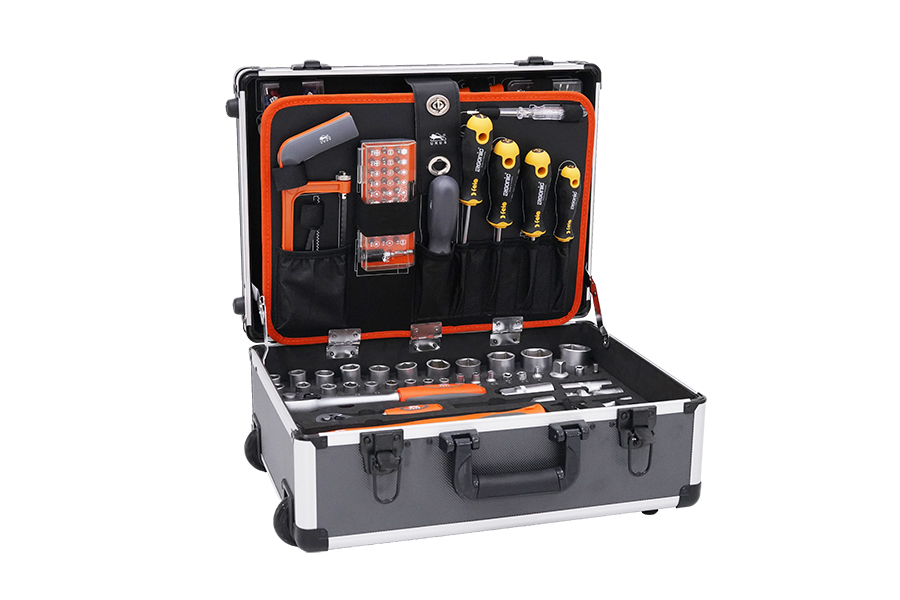
The market for electric tool accessories — saw blades, drill bits, grinding wheels, router bits, and oscillating tool attachments — is segmented less by brand than by underlying material science and manufacturing tolerance. Two drill bits at vastly different price points may appear identical in photos, but differ significantly in point geometry precision, cobalt content in HSS alloy, and coating thickness uniformity.
Key evaluation criteria for common accessory types:
Total cost of ownership — not unit price — is the rational procurement metric. A premium blade completing 800 linear feet before replacement outperforms a budget blade requiring replacement at 200 feet, even if the unit price difference is 3:1.
Construction tools span a wide performance range within the same product category, and specifying the wrong class for the structural task is a common source of rework and equipment damage. Rotary hammers illustrate this clearly: light-duty models in the 1–2 joule range handle anchor installation in hollow-core concrete block; medium-duty 3–5 joule tools cover rebar drilling and anchor setting in solid concrete; heavy demolition and core drilling in structural concrete requires 8–15 joule SDS-Max or spline-drive class tools with active vibration reduction systems.
For framing and steel construction, pneumatic nailers remain the preferred tool for volume fastening despite the expansion of cordless brushless platforms — a pneumatic framing nailer can drive 8,000–10,000 nails per day consistently, while even top-tier cordless nailers currently perform best in the 2,000–4,000 nail range before thermal throttling or battery management intervenes. Cordless nailers add value in finish and trim work, remote locations, or where compressor setup time is prohibitive.
Concrete cutting workflows increasingly favor diamond blade wet-cut track saws over traditional angle grinder methods for three reasons: dimensional accuracy (cut path deviation under 1mm over 3 meters), dust suppression (wet cutting reduces respirable silica generation by over 90% compared to dry cutting), and blade longevity (water cooling prevents segment bond softening that causes premature diamond exposure loss). Where water management on site is impractical, vacuum-shrouded dry-cut systems with HEPA filtration are the regulatory-compliant alternative in markets with silica dust exposure limits.
Even high-quality accessories degrade prematurely under poor storage and maintenance conditions. Drill bits stored loosely in a metal toolbox suffer tip damage from contact with other bits and tools; indexed drill index cases or foam-lined rolls prevent this without adding significant storage overhead. Saw blades stored horizontally under stacked weight warp over time, particularly thin-kerf variants — vertical blade storage racks eliminate this failure mode entirely.
Reconditioning is economically viable for several accessory categories that are routinely discarded prematurely:
Humidity control in storage areas also matters for accessories with ferrous components. Relative humidity above 70% accelerates surface oxidation on uncoated HSS bits and saw plate bodies. Desiccant packs or climate-controlled storage cabinets pay for themselves quickly in high-humidity workshop environments where accessory rust-out is a recurring issue.
I. Introduction: Solving the "Impossible" Task The phrase "fitting a square peg into a round hole" is a universal symbol...
READ MOREMetalworking has always been a cornerstone of industrial development, shaping everything from automotive components to a...
READ MORE1. What Are Waterpump Pliers? – The Flexible “All-Rounder” Tool In modern industrial manufacturing and daily maintenance...
READ MORESelecting the appropriate industrial cutting tools is a critical decision that directly impacts manufacturing efficiency...
READ MORE
+86-573-84611229

+86-573-84611518


NO.35 Yucao Road, Ganyao Town, Jiashan City, Zhejiang Province, China
