

 中文简体
中文简体 English
 русский
 Inquiry
Don't hesitate to send a message
I. Introduction: Solving the "Impossible" Task The phrase "fitting a square peg into a round hole" is a universal symbol...
READ MOREContent
A masonry hammer drill bit is a carbide-tipped rotary cutting tool designed specifically for drilling into concrete, brick, stone, mortar, and other hard masonry materials. Unlike standard twist bits that rely on rotation alone, masonry hammer drill bits are engineered to work with a hammer drill's percussive action — combining rapid axial impacts with rotation to fracture and pulverize material ahead of the cutting edge rather than shearing it.
The key component is the tungsten carbide tip brazed or sintered onto the working end. Tungsten carbide rates approximately 9–9.5 on the Mohs hardness scale, making it hard enough to withstand the repeated shock loading that would fracture or dull conventional high-speed steel (HSS) or cobalt bits within seconds of contacting concrete. The flutes running along the shank serve two functions: channeling dust and debris out of the bore hole during drilling and providing some measure of flute reinforcement to resist torsional stress during impact.
The percussion mechanism in a hammer drill delivers between 20,000 and 50,000 blows per minute (BPM) at low stroke amplitude. Each blow chips the aggregate and cement paste while the rotation sweeps loose particles into the flutes. This combined action makes masonry hammer drill bits 2–5 times faster than attempting the same bore with a standard rotary bit, and far less likely to overheat and lose temper.
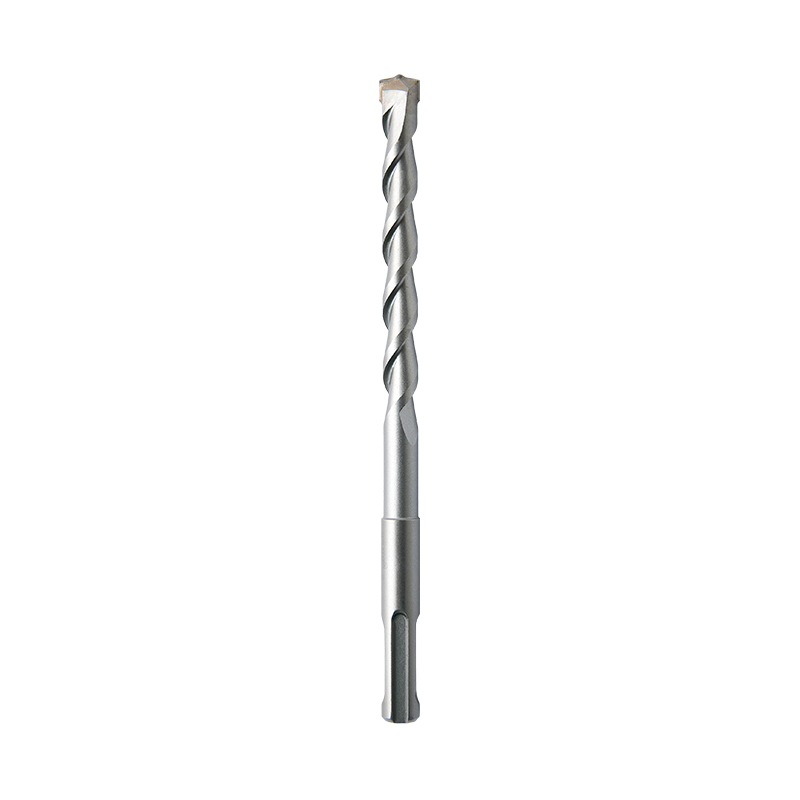
Selecting the correct shank is as important as choosing the right carbide geometry. Using the wrong shank in the wrong chuck can damage both the bit and the tool.
The most common shank for DIY and light-to-medium professional hammer drills. The SDS-Plus shank has two open grooves and two closed indentations that allow 10 mm of axial float — the bit slides back and forth freely within the chuck rather than being clamped solid. This freedom of movement is essential: it prevents the hammer mechanism from transmitting destructive shock loads back through the chuck into the motor bearings. SDS-Plus bits are available in diameters from 4 mm to 26 mm and are the standard choice for drills rated up to about 4 joules of impact energy.
SDS-Max shanks are 18 mm in diameter (versus 10 mm for SDS-Plus) and feature three open grooves. They are intended for heavy rotary hammers rated above 4 joules — tools used in demolition and large-diameter core drilling. SDS-Max masonry bits start at 12 mm and can exceed 50 mm in diameter. The increased shank cross-section provides the mass and rigidity to handle higher impact energies without the shank deforming or the bit walking off-center.
Older or budget hammer drills use a conventional three-jaw keyed or keyless chuck. Round-shank masonry bits fit these tools, but because the shank is clamped rather than floating, impact energy transmission efficiency is lower and chuck wear accelerates. Round-shank bits are still widely used for light-duty work and with corded drills in hammer mode when SDS tooling is unavailable.
| Shank Type | Chuck Compatibility | Typical Diameter Range | Best For |
|---|---|---|---|
| SDS-Plus | SDS-Plus rotary hammer | 4–26 mm | General construction, anchor holes |
| SDS-Max | Heavy rotary hammer (4 J+) | 12–52 mm | Large-diameter bores, demolition |
| Round Shank | Keyed / keyless 3-jaw chuck | 3–20 mm | Light-duty, older drills |
The geometry of the carbide insert determines how aggressively a bit attacks different substrates and how long the cutting edge survives before requiring replacement.
The most basic geometry: a single flat carbide plate ground to a chisel edge and pressed into a milled slot at the drill tip. Flat cross tips are inexpensive, suitable for soft brick, cinder block, and low-strength concrete. The main limitation is that the flat edge has a relatively small contact area with aggregate particles, which reduces chip-clearing efficiency in dense concrete and causes the tip to wear asymmetrically on mixed aggregate substrates.
Two carbide plates intersect at 90° to form an X-shaped cutting head. The additional cutting edges improve centering, reduce walking on entry, and distribute wear across four contact points instead of two. Four-cutter bits typically outlast flat cross tips by 30–60% in reinforced or high-aggregate concrete. Most professional-grade SDS-Plus bits use this geometry.
The entire tip face is solid or nearly solid carbide. Full-head bits are substantially heavier at the working end, which increases mass-based impact energy delivery per blow. They are preferred for very hard granite, quartzite, or basalt where aggregate hardness exceeds what a small insert can resist without shattering. These bits cost significantly more but may be the only viable option for drilling into extremely dense natural stone without excessive bit consumption.
Matching bit specification to substrate and application is the single most important factor in achieving clean holes efficiently without premature bit failure.
Diameter selection should match the anchor or fastener manufacturer's specified hole size exactly. Oversized holes compromise anchor load capacity; undersized holes prevent proper sleeve expansion. Most chemical anchors also specify a minimum embedment depth, which dictates the required flute length.
Even a high-quality masonry hammer drill bit will fail prematurely if used incorrectly. The following practices directly affect bit longevity and hole quality.
Apply steady, moderate forward pressure — enough to maintain tip contact with the substrate, but not so much that the drill motor bogs down. Excessive pressure is the most common cause of premature carbide tip cracking. The percussive mechanism needs room to generate axial float; forcing the bit forward reduces stroke distance and impact energy per blow. A consistent light-to-moderate feed rate produces the fastest, cleanest hole.
Larger diameter bits require lower RPM. Most rotary hammers have two-speed gearboxes; use low gear for bits above 16 mm. High rotational speed with a large-diameter bit concentrates heat at the carbide brazed joint and can cause tip delamination. As a general guide:
Periodically withdraw the bit while still spinning to allow flutes to evacuate cuttings. In deep holes (depth-to-diameter ratio above 5:1), failure to clear dust causes compaction — the packed cuttings create hydraulic-like resistance that dramatically increases drilling torque and heat. In some cases, compacted dust can thermally bond to the flutes and lock the bit in the hole.
Unlike metalworking operations, water cooling is rarely used with masonry hammer drill bits. Instead, allow the bit to air-cool between holes when drilling in series. Touching the carbide tip after a deep bore will confirm if thermal buildup is occurring. Persistent overheating (tip too hot to touch after a standard-depth hole) indicates the bit is undersized for the impact energy or the substrate is exceptionally dense.
Masonry hammer drill bits have no rake angle suitable for chip formation in ductile materials. Using hammer mode in steel work-hardens the surface and destroys the carbide tip within seconds. Always confirm the drill is in rotation-only mode when not drilling masonry.
Carbide tips do not fail suddenly under normal use — wear follows a predictable progression that, if recognized early, allows replacement before productivity and hole quality degrade significantly.
Unlike HSS bits for metalworking, masonry hammer drill bits cannot be reground in the field. The carbide tip geometry requires precision grinding equipment. For most users, the economics of bit replacement versus tip reconditioning strongly favor replacement, particularly for SDS-Plus bits below 16 mm.
Masonry drilling generates significant hazards that require active management, not just awareness.
I. Introduction: Solving the "Impossible" Task The phrase "fitting a square peg into a round hole" is a universal symbol...
READ MOREMetalworking has always been a cornerstone of industrial development, shaping everything from automotive components to a...
READ MORE1. What Are Waterpump Pliers? – The Flexible “All-Rounder” Tool In modern industrial manufacturing and daily maintenance...
READ MORESelecting the appropriate industrial cutting tools is a critical decision that directly impacts manufacturing efficiency...
READ MORE
+86-573-84611229

+86-573-84611518


NO.35 Yucao Road, Ganyao Town, Jiashan City, Zhejiang Province, China
